
In this article, we’ll cover the top Loopio alternatives in 2026:
- Conveyor: Unified trust center + advanced, accurate AI for RFP/security automation; plus, AI managed knowledge library
- Responsive: Legacy proposal management software, automation across RFPs/RFIs/DDQs with collaboration
- Tribble: Slack/Teams-first SME routing + cited AI answers tailored to deal context
- Arphie: Source-cited drafting from Google Drive/SharePoint/Confluence; confidence scoring for reviewers
- AutoRFP: RFP response automation with unlimited users
Sales has promised the RFP (request for proposal) by Friday. The proposal manager is still waiting on a product answer, but is so busy rewriting responses, they have no time to hunt down their SME (subject matter expert). Across the company, a security analyst opens an incoming security questionnaire to find 200 questions that have answers, somewhere.
Both the RFPs and the security questionnaires can hold up revenue, but they’re usually answered by different teams working in different tools.
- Proposal managers, sales engineers, and presales teams own the RFP response: how the product meets the buyer’s needs and why it deserves to win.
- Security, GRC (Governance, Risk and Compliance), or Customer Assurance teams handle the security questionnaire: what controls exist, what evidence supports them, and what the company can safely claim. In smaller companies, people may cover both jobs.
For both of these, teams share knowledge and pull in many of the same experts, but an answer that satisfies one team may leave the other with work to do. A polished paragraph won’t resolve a precise question about data retention. A technically correct product description won’t explain why it matters to the prospective buyer.
That’s the starting point for choosing a Loopio alternative. Are answers generated by an AI solution able to provide the quality required RFPs and the accuracy required by security questionnaires?
At the end of the day, how much rewriting, checking, and chasing does the tool remove?
Why teams look past Loopio
Loopio supports proposals and security questionnaires, with AI drafting, content management, and collaboration.
Here are a few reasons team consider switching:
- Proposal writers still having to re-write most answers by hand
- Security can’t rely on AI and has to check every response against the source
- Teams having to manually manipulate file formats before uploading
- Document requests and portal questionnaires are handled outside the tool
- The answer library is a pain to manage
A tool can work well for one department and leave another doing too much manual work. Bring both teams into the evaluation if both will depend on it.
How to evaluate these tools
Feature lists look nearly identical across this category. Here are five questions that make the differences clearer when you’re in evaluation mode.
- How accurate is the first pass of answers? Run your hardest security questionnaire and your last RFP through every finalist using the same source material. Have each team count answers it would send with zero edits. For the RFP, check whether the answer makes the case for this deal as well as getting the facts right.
- Does the automation for third party portals actually work? Test the portals your customers use, whether that’s Whistic, Venminder, OneTrust, or SAP Ariba. See if you can complete a full portal questionnaire end-to-end, including dropdowns, follow-up fields, and attachments. A browser extension, an exported spreadsheet, and direct portal completion can leave very different amounts of work for your team.
- How does the knowledge base stay current? Every tool here relies on your content. Update a source document and see what happens to the next answer. Ask how the tool handles conflicts, retires stale information, and learns from corrections. If maintenance is a manual chore nobody owns, it will always be a challenge to keep it current.
- Who owns it internally? Is the tool’s main user a proposal manager, a sales engineer, or a security analyst? Who manages content and approves answers? A proposal-led workflow and a security-led workflow need different review controls and integrations. Ask vendors to show how they support your primary team today and where they’re investing next.
- Can buyers self-serve documents in a Trust Center or portal? Security questionnaires often come with requirements to send a SOC 2 or other security documentation. Can a buyer get an approved document and a supported answer without sending your team another request? See if the tool has a Trust Center option (a secure portal for sharing security docs, assessments, and FAQs with prospects/customers) that has access controls, NDA handling, and understand what happens when the system can’t answer. Buyer self-service is important because resolving a request before it reaches your queue removes a lot of extra work.
Loopio alternatives to evaluate
1. Conveyor
Conveyor connects security questionnaire automation, RFP response automation, AI knowledge management, and an agentic Trust Center on one platform. It covers the whole customer trust process, from a request arriving to a finished response going back out.
The main features are:
- Automated intake by AI. A request to complete an RFP or questionnaire lands from Slack, Salesforce, Jira, or Zendesk, and an agent will process and complete it based on your rules.
- AI that drafts answers based on the context and understands the difference between answers for RFPs and security questionnaires. It drafts from approved documentation, shows the sources behind every answer, and routes what it can't answer to the right expert group. Proposal teams use the same answer engine but apply different context. An RFP project takes background materials plus your read on the prospect, including win themes, priorities, and competitive insights, so answers speak to the opportunity instead of reciting library content.
- AI-maintained knowledge library connected to all sources: Conveyor connects to source documentation and an AI Librarian flags duplicates, understands past answers, recency so that you don’t have to manage thousands of Q&A pairs.
- The agentic Trust Center does more than share documents. Buyers get your documentation behind NDA and access controls and can ask the agent questions directly. They can also upload their own questionnaire and get it back completed by email, answered only from content they're approved to see and only where the agent can cite its source.
- Analytics and enterprise roles and permissions. Report on security or RFP influenced revenue, track trust center downloads and activity, and do it all through your LLM of choice with Conveyor’s MCP AI connector (Model Context Protocol integration for your chosen LLM).
Best fit: Enterprise B2B companies with recurring customer security reviews and RFPs, where security or customer assurance teams need to work closely with sales and presales.
2. Responsive
Responsive brings response projects, requirements analysis, and collaboration together across RFPs, RFIs (request for information), DDQs (due diligence questionnaires), and security questionnaires.
Its breadth is useful when the challenge is keeping a large response effort organized. AI helps draft answers from approved content, while review workflows give contributors a way to complete their part. Responsive also offers a trust center for sharing security information; this was added more recently.
Give the AI a thorough test. Run both a questionnaire and RFP through the solution and see if it can apply nuance and context to both. Different types of questions require different answers. Most of the time, legacy software can’t differentiate between the two.
Also, understand how the library will be maintained. Oftentimes, when teams have to manually update, add past answers from completed RFPs/questionnaires, maintenance becomes a burden.
Best fit: Companies with a dedicated proposal function, several business units, and bids that require many contributors and approval steps.
3. Tribble
Tribble connects company knowledge with deal context, drafts cited answers, and routes low-confidence questions to experts in Slack or Teams.
That approach can reduce the back-and-forth between the person preparing the response and the person who knows the answer. It also brings buyer priorities and win themes into drafting, so the response can reflect what sales learned during the deal.
In an evaluation, follow one question through that handoff. Check whether the expert gets enough context to help and whether the approved answer becomes useful the next time it’s needed. Also, Tribble was first an RFP solution. Again, check and see if it can handle the nuances required of questionnaire answers vs. RFP answers.
Best fit: Sales engineering and proposal teams that rely on busy experts across departments and use Slack or Teams to coordinate responses.
4. Arphie
Arphie connects to sources such as Google Drive, SharePoint, and Confluence, and shows sources and confidence scores alongside generated answers.
For reviewers working outside their own specialty, that can make it easier to check a claim without tracking down the document’s author. Arphie also supports collaboration and duplicate Q&A cleanup.
Test a question that draws on conflicting sources. What matters is whether the evidence supports the answer and makes the disagreement easy to resolve. Tribble was also an RFP solution first so you’ll need to check and see if it can handle the nuances required of questionnaire answers vs. RFP answers.
Best fit: Presales and response teams whose product and technical knowledge is spread across shared drives and internal documentation.
5. AutoRFP
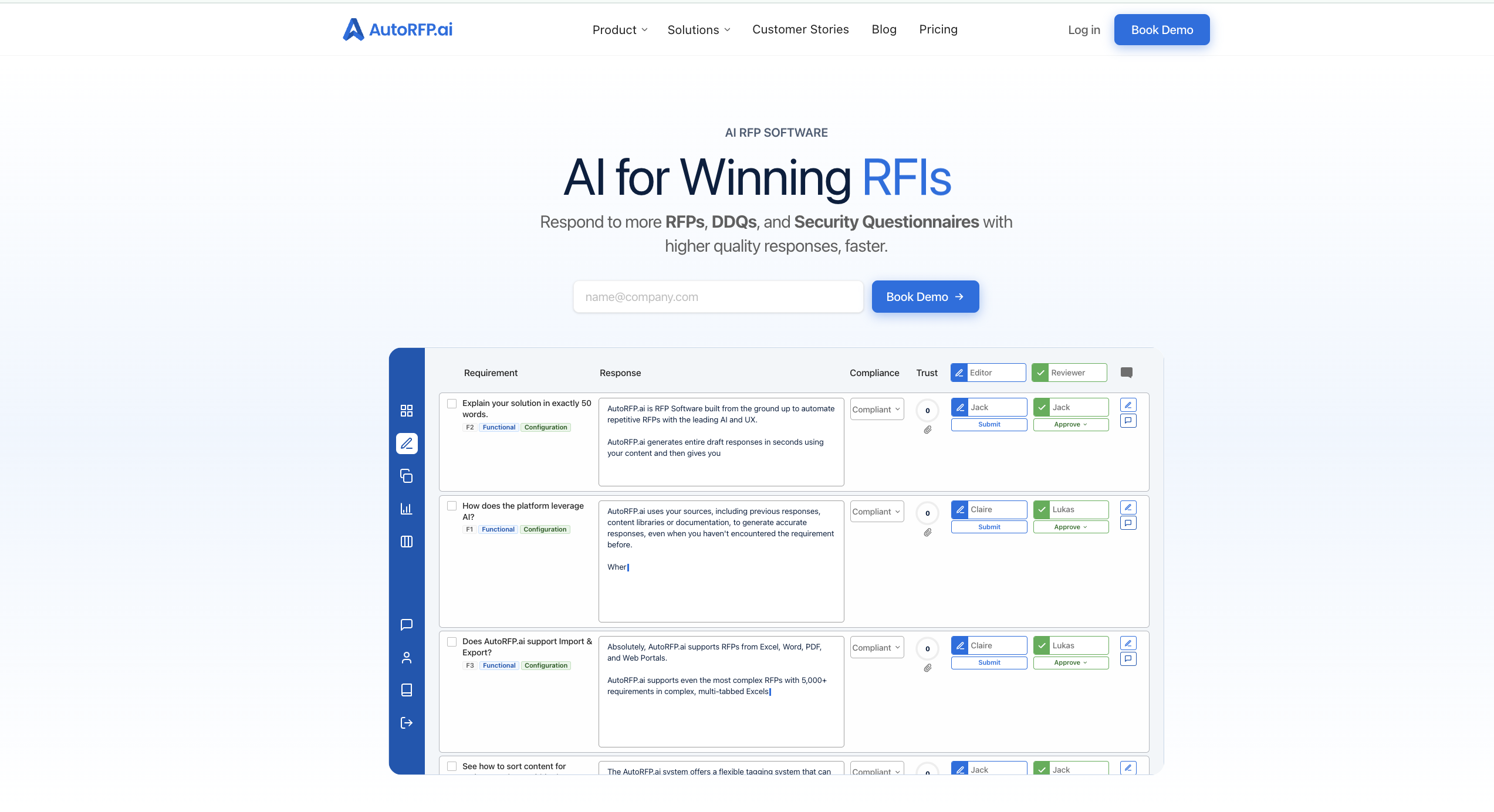
The answers are approved, but someone still has to put them into the customer’s workbook and check every field. AutoRFP.ai supports Excel, Word, PDF, and portal workflows, with export into customer documents or branded templates.
It combines drafting with editor and reviewer assignments, and its plans include unlimited users. That can make it easier to involve specialists without buying a seat just for occasional contributions.
Bring a difficult workbook or Word file to the demo. Check extraction and export and see if it can differentiate between security questionnaire answer and RFP answers. Most RFP-first tools aren’t as strong here.
Best fit: Lean proposal or sales engineering teams handling varied RFP formats and bringing in occasional reviewers from other departments.
Frequently asked questions
Does Loopio handle security questionnaires?
Yes. Loopio supports security questionnaires alongside RFPs, RFIs, and DDQs, but accuracy can be spotty. Test its answers and review workflow against your own security requirements rather than assuming a proposal tool can or can’t do the job.
Can one tool serve both teams?
Yes, if each team can control its sources, instructions, ownership, and approvals. Both need accurate answers based on the file being answered. Proposal teams also need responses tailored to the opportunity; security teams need precise claims backed by evidence.
What’s the best Loopio alternative for a small security team?
Prioritize answers that need little correction, support for your customers’ portals, and buyer self-service. Conveyor is worth evaluating when questionnaire completion and routine document requests consume the same team’s time.
What should I test during an evaluation?
Use the five questions above as your scorecard and what to ask every vendor checklist above. Have the people who do the work review the output, handle an exception, and check the final submission. Count review and cleanup time as well as drafting time.
What happens to our existing Loopio content if we switch?
Ask each vendor which content, tags, and ownership details it can migrate, who handles cleanup, and what it costs. Keep useful approved answers, retire duplicates and stale content, and connect source documentation where possible.
Why teams choose Conveyor
Sprout social saved nearly 200 hours annually on a security questionnaires.
That result matters because the saved time belonged to a security team with other work to do.
“At Carta, we ran a 77-question spreadsheet through Conveyor. It answered 72 of them perfectly. What used to take days now takes 20 minutes.”
Callie Dedinsky, Senior GRC Analyst, Carta
Your proposal and security teams will have their own standards. Bring a recent RFP and a difficult security questionnaire, along with the material each team uses to answer them. We’ll work through both so you can judge the answers, the handoffs, and the effort left before submission.
.png)
-p-1600.avif)