
Overnight the RFP process got flooded with AI. The document that lands in your inbox was drafted with AI. You'll use AI in your response. Then the buyer will run your response through AI. As of today, this is pretty much the default as AI adoption in RFP management sits at 63.9%, and reaches 81% among the most mature response teams. AI is already on both ends of the transaction.
With AI, the cost of issuing an RFP has essentially dropped to zero. It's cheap, so longer RFPs go to more vendors. That means more and more work for proposal teams.
68% of organizations say their proposal volume is climbing (QorusDocs 2026). That might mean more opportunities, but it also means much more work. Three deadlines in the same week. A compliance matrix you're mapping by hand. Twenty-two questions sitting with a subject matter expert who touches an RFP twice a year.
At the same time, these teams aren't growing. Management might understand the need is real, but the mandate today is "use AI to solve it." What really happens is you offload work onto sales and SEs to respond to RFPs. Not ideal.
Proposal people are smart, though. Everyone we talk to is using AI to fight back. Those who use a legacy RFP tool have tried its AI, but it just doesn't work. They claim magic and deliver mediocre. It's retrieval with a chat box on top, and the answers show it.
ChatGPT, Claude, and the slew of AI wrappers built on those tools are quick and fun. But they aren't purpose built for large organizations. They struggle with scale, governance, accuracy, and complex file types. Fast to start, but you never quite get it to 100% in production.
These solutions speed you up a little, and the win rate pays for it. That can't happen in the proposal response world.
Most teams stop there. They struggle to use AI to scale their RFP process and throw their hands up. They work more and win less.
But not everyone. Some teams we talk to have built an amazing in-house solution. They've customized one of the big LLMs to ingest RFPs and hold context, and trained it to match their requirements. They've trained it on a custom knowledge library they maintain daily. They've built custom scripts to deconstruct different file types. They've rolled it out to sales through training and skills they have to keep current. They've constructed elaborate project management systems to make it all work.
The problem is this is all they do. And it still doesn't work the way they want it to. It's more of a dream than a real solution. But it's a good dream, and one we can build.
The all-new Conveyor AI RFP software
We've rebuilt our RFP solution to deliver this: AI that brings judgment to the work, not just automation. We want to speed you up and increase your capacity, but with AI that answers as close to the way you would as possible. That means answering with the intelligence of a smart, seasoned proposal manager. To do this we had to solve a number of problems we hadn't solved yet, and that you certainly won't get from Loopio or Claude.
A quick note on the name. We call this RFP software because that's the term people use and search for. But it handles the whole RFx family, not just RFPs. RFIs, RFQs, and the other response documents your team fields all run through the same engine, so you never switch tools by format.
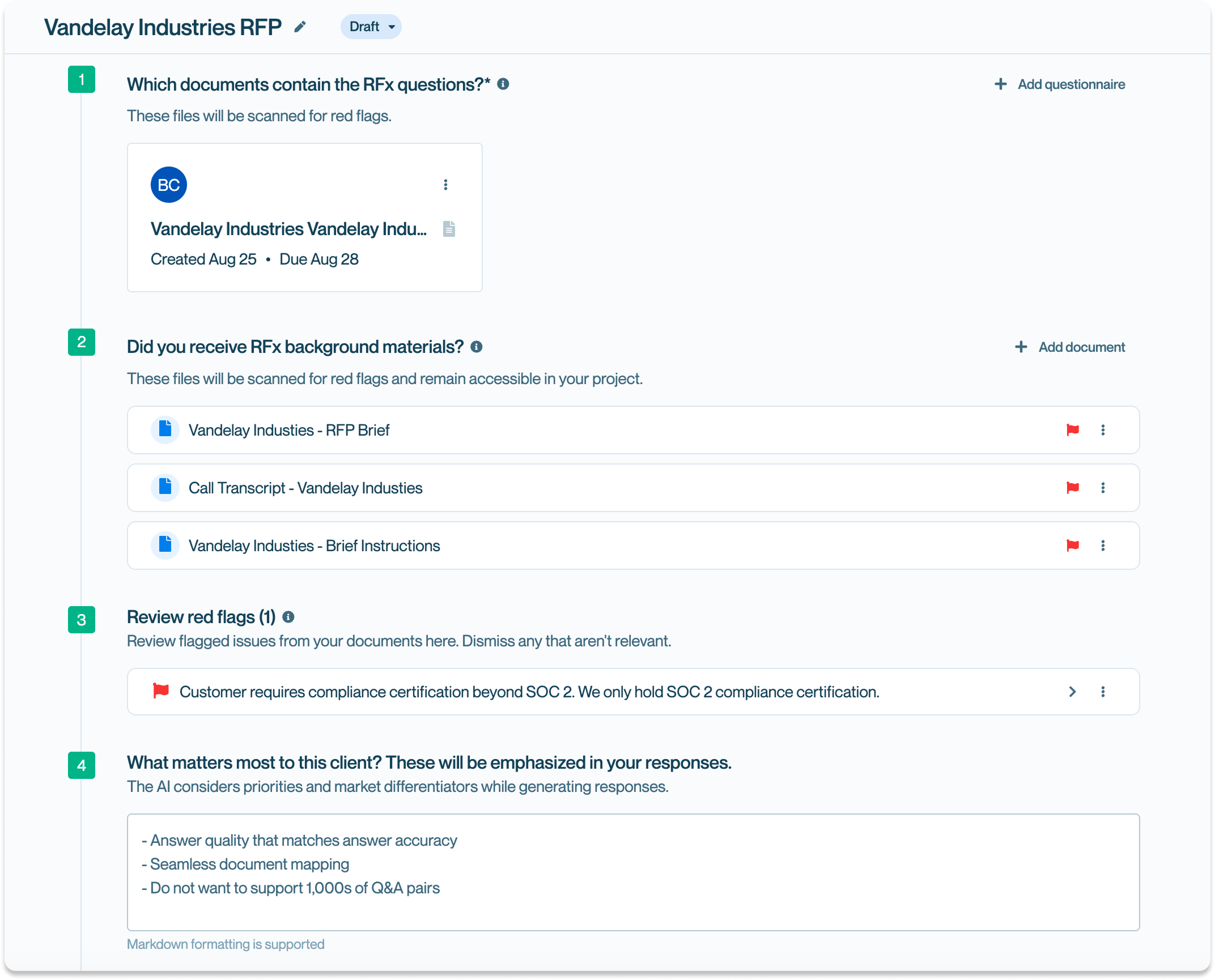
Better answers
It's the single most important thing an AI RFP solution should deliver. Speed, automation, project management, integrations, all important, but if the answers are bad, none of that really matters.
Before today, ConveyorAI's RFP answers weren't special. Hundreds of customers run their security review process on our AI at 95%+ first-pass accuracy. But RFPs are not security reviews.
To win an RFP you need great answers, and "great" is subjective. That creates a hard problem to solve. Delivering fast or technically accurate answers is an easier problem from a technical perspective. Our approach to this challenge is based on what makes a proposal writer great. They have context, experience, and a specific point of view. For RFP we strive to give ConveyorAI all of those same ingredients.
Conveyor's advantage has always been the accuracy we've been able to deliver. We honed it by delivering security review automation to security teams at some of the world's largest companies, Lucid Software got time per question from four minutes down to twenty-two seconds, a 91% reduction, and Sprout Social automates 98% of its questionnaires. For RFP we turned that same accuracy engine on proposals. The result is AI that delivers intelligence, not just speed. You move faster and win more. This is the core innovation of the new RFP solution.
"Security questions need concise precision; proposal questions need persuasion. Conveyor's response engine now knows the difference, so every question gets answered the way it needs to be in order to win the deal."
— Kyle Taylor, AI RFP Product Lead at Conveyor
ConveyorAI learns about the deal before it works on questions. An RFP arrives from Salesforce, and Conveyor ingests the RFP, the sales brief, and any deal documents. It then answers questions with rich context. Once it answers, it goes back and applies your win themes to those answers. This is not just answer retrieval. Our research and testing show this method delivers better answers, and we're always improving the engine.
We’ve also added a verbosity setting for answer length, because a yes/no SOC 2 question shouldn't come back as three paragraphs.
Your expertise transfers to the AI. Experienced humans are great at judging how to read a bid, which requirements are most important, and how much to say. Machines are not. With Conveyor you build that judgment into the AI once and apply it to every RFP.
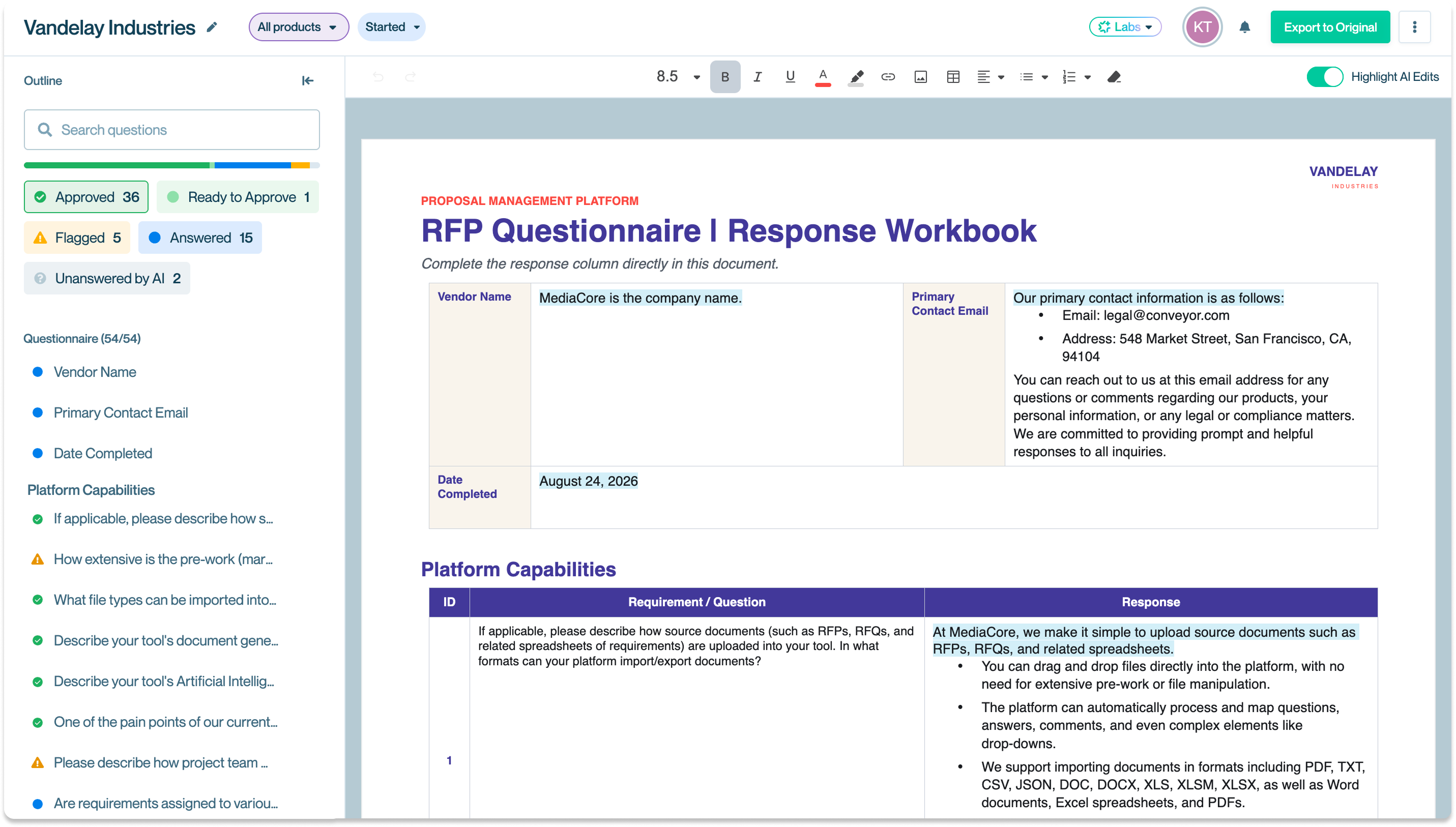
Better document intake
As you know, RFPs come in all shapes and sizes. Another surprisingly technical challenge. An engineer on the team likes to say it's easier to build rockets than Microsoft Word import for RFP. That said, they did it.
We're very confident in our ability to take in RFPs from spreadsheets and from integrations like Salesforce and Jira. And as of today we're very happy with how ConveyorAI handles even the ugliest Word documents and PDFs. 94% of imports now come back answered with zero edits, at a median of 1 minute 41 seconds to first answer.
You'll now experience a totally rebuilt Word import. What comes in closely resembles the source document, at high fidelity, in the browser. Answers populate inline where they belong, with the rest of the document right there. Conveyor is the only tool that does this. Responsive answers in Grid or List views; Loopio in its Project workspace entry list.
We've also added a new review step during intake. The agent reasons over the brief and background material and produces a plan you can comment on and adjust before it runs a full answering pass.
Expect Conveyor to handle any doc. Multi-tab workbooks, merged cells, nasty Word files, you name it. Exports come back with formatting intact. Gaps route to subject matter experts in Slack without logging in, and collaborators are unlimited, so nobody pays a seat license to answer two questions a quarter.
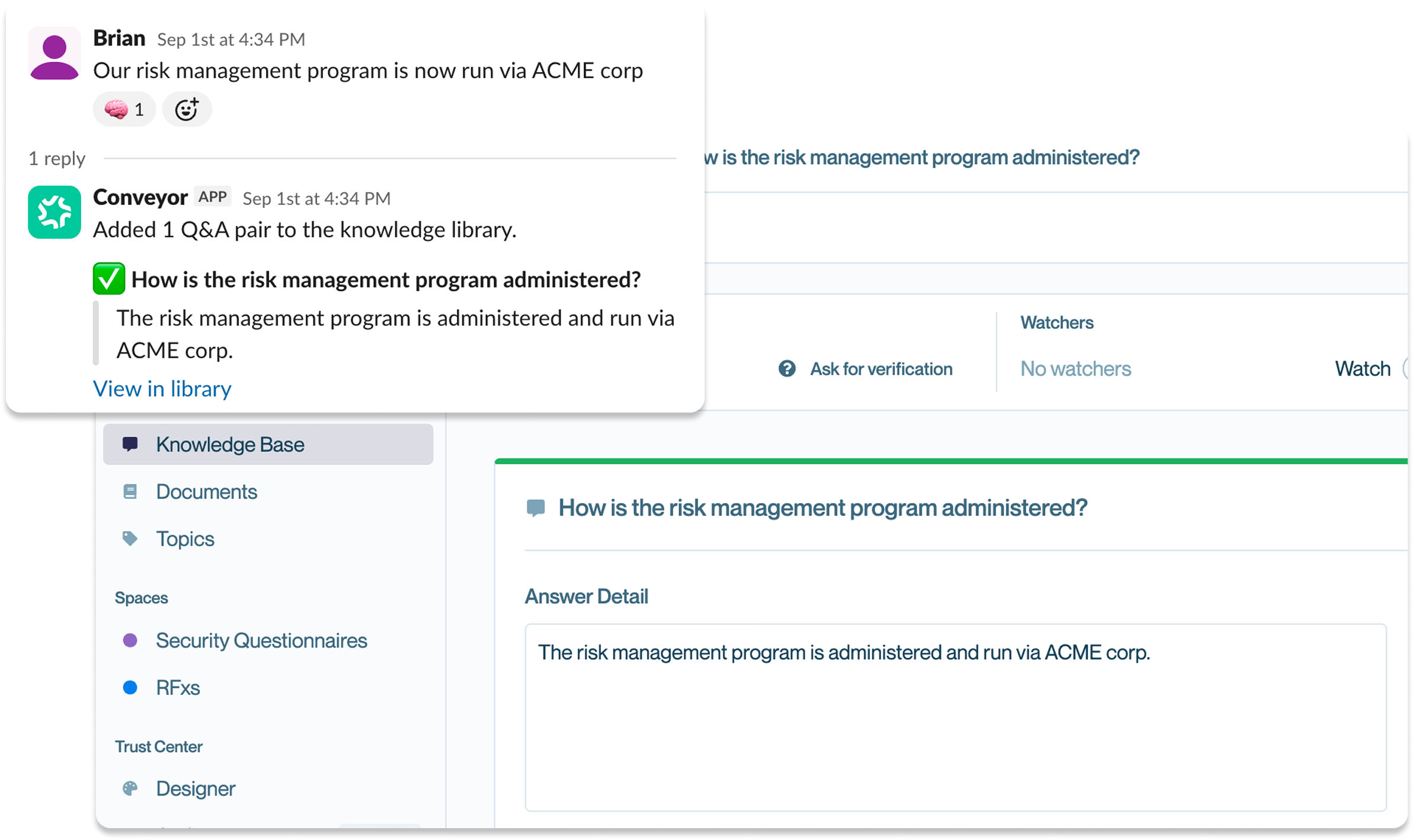
Knowledge management
AI built on a poor knowledge base delivers slop. And who has time to constantly update their knowledge library? AI can and should solve this, and now with Conveyor it can.
With Conveyor, every human edit and every manual answer is saved and marked reusable. Customer-identifiable details get stripped automatically, and when two sources disagree, the newer one wins. Your team answers RFPs; the knowledge base gets smarter as a byproduct.
Four source types feed every answer: Curated Q&As, Documents (PDF, DOCX, XLSX and more), Past Answers, and External Sources. Everything except Curated Q&As can be toggled per RFP, so a proposal doesn't get answered out of your security library. Google Drive, Confluence, and Notion sync today, and as of this month, so does SharePoint.
Note how little of it you have to maintain: fewer than 400 curated Q&A pairs, where a legacy tool wants a thousand or more.
To improve retrieval we've added Topic Preferences, instead of relying solely on your Knowledge Library, you can define a topic (such as breaches, liability, or data residency) and tell ConveyorAI exactly how to handle questions that fall under it.
Then there's Slack. React to a thread with a 🧠 (or whatever emoji you choose) and ConveyorAI reads the whole thing, extracts up to ten Q&A pairs, checks each one against your Knowledge Library for conflicts, and posts back for approval. SMEs can also search the knowledge base and answer one-off questions right in the channel, no login. Nobody else does this. Loopio has no way to add or edit Library content from Slack. Responsive lets you manually add a single pair, that means no thread reading, no conflict check, no editing what's already there.
Take a look
Legacy AI solutions and off the shelf LLMs are creating more work and more headaches for most proposal teams. If you'd rather it created leverage, it's time to take a look at the new Conveyor AI RFP software. We’d be happy to show you what makes Conveyor different, book a call.
.png)


-p-1600.avif)