For most prospects, getting security information from a vendor is rarely as fast as they'd like. But for customer trust teams, the pressure builds as security questionnaires stack up, NDA requests slow down deals, and sales cycles stall while prospects wait for answers. What looks like a compliance task is often your biggest operational bottleneck.
The right Trust Center software changes that equation. Instead of manually responding to every request, it creates a self-serve, AI-powered source of truth where prospects access certifications, policies, and answers on their own. The result is faster deals with less manual work, and a security review process that builds trust and scales without adding headcount.
Let's compare the leading Trust Center software options side-by-side.
What is Trust Center software and why your business needs it
Trust Center software centralizes, automates, and scales how your company shares security and compliance information with customers. Instead of manually responding to every request, it creates a single, self-serve source of truth where prospects can access certifications, policies, and answers instantly.
According to the Sophos 2026 Cybersecurity Trust Reality Report, only 5% of IT leaders say they fully trust their cybersecurity vendors, and 51% say a lack of trust increases anxiety about major incidents. Buyers have grown skeptical of vendor assurances and want verifiable proof instead.
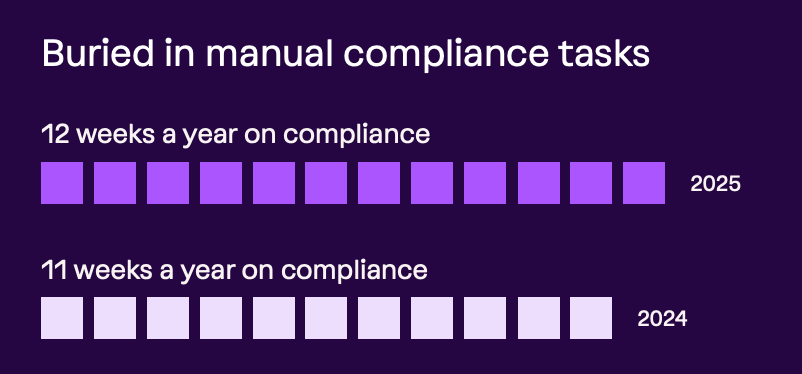
At the same time, internal teams are stretched thin. Vanta's 2025 State of Trust Report found that 61% of leaders spend more time proving security rather than enhancing it, with teams losing around 12 weeks per year to compliance work. And yet 82% say stronger security and compliance directly increases customer trust. The work is unavoidable, but the way most teams are doing it isn't sustainable.
Customer trust teams are fielding security reviews, managing NDA requests, and responding to security questionnaires across email, spreadsheets, and portals often with far fewer people than the volume demands. Every request pulls time away from actual security work. Every delay slows the deal.
Trust Center software changes that. It centralizes how your company shares security information with customers and automates the workflows behind it, creating a self-serve source of truth where prospects can access certifications, policies, and answers instantly without waiting on your team. Sales teams send one link instead of chasing documents, security questionnaires get answered from existing documentation, and SOC 2 reports are available on demand.
How to choose the right Trust Center software for your organization
You're not just shopping for another SaaS tool. You're choosing the platform that determines whether your 3-person team can handle thousands of security reviews and support hundreds of sales team members without burning out or killing deals. The right one doesn't just speed up your workflows. It helps you build trust with the buyers evaluating you.
Focus on capabilities that remove manual work and directly impact deal velocity.
- Prioritize AI accuracy for security workflows: Look for platforms with proven accuracy in answering security questionnaires and customer questions. Low accuracy creates rework and kills trust internally. High accuracy lets your team rely on AI for real-time responses using your security documentation as the source of truth.
- Choose platforms with deep, native integrations: Your Trust Center should connect directly to systems like Salesforce and HubSpot. This is how you track engagement, tie security reviews to pipeline, and give sales teams visibility without extra steps. If integrations rely on workarounds, reporting and automation will break down fast.
- Validate scalability across complex environments: Enterprise teams don't run a single product or a single workflow. Look for support across multi-product trust portals with separate security documentation, global access with auto-translation, and granular roles and permissions across teams and customers.
- Real workflow automation, not just document hosting: A trust portal alone doesn't remove the bottleneck. You need automation across security questionnaire responses, NDA routing and approvals, and document requests and follow-ups. This is where teams actually win back time.
- Clear, measurable ROI metrics: The platform should show faster response times, higher self-serve rates, and shorter sales cycles. If it can't connect Trust Center activity to deal progression, it's not solving the core problem.
Best Trust Center software solutions for 2026
The best Trust Center software does more than host security documentation. It automates security reviews, workflows, and security questionnaire responses, so customer trust teams can scale without slowing the sales cycle.
Enterprise teams need platforms that handle complex security postures, multiple products, and real-time access to security information. Different platforms solve different parts of the customer trust problem. The right choice depends on how you manage security reviews, compliance workflows, and customer scale in practice. Here's how the leading solutions compare.
Conveyor
Conveyor is built for enterprise customer trust teams managing high volumes of security reviews and security questionnaires across multiple products, regions, and compliance requirements. That combination of scale and complexity is where most tools fall short, which is why teams need a unified customer trust platform with Trust Center, security questionnaire automation, sales self-serve and analytics all using one knowledge library, not a patchwork of disconnected solutions.
.png)
Its core differentiator is an AI-powered Trust Center Agent that answers customer questions and generates accurate questionnaire responses using your existing security documentation, certifications, and knowledge base. This removes manual work from the review process and enables real-time, self-serve access to audit-ready information.
Key capabilities for enterprise environments:
- Multi-product trust portals: Manage separate product information, all on one Trust Center page, each with its own security posture, documentation, and permissions
- AI-driven security questionnaire automation: Generate consistent, accurate responses across questionnaires and customer requests
- Global access and translation: Deliver localized security information to international buyers automatically
- Enterprise-grade permissions and access controls: Protect sensitive documents while enabling controlled sharing
- Deep integrations with Salesforce and HubSpot: Auto-approve Trust Center access for visitors based on CRM data and sync Trust Center activity with pipeline data and sales workflows
- Workflow automation: Automate the entire workflow from auto-approving customers for Trust Center access, to one-click NDAs, to allowing customers to self-serve everything in one place with an AI Agent to help when they get stuck
Conveyor also provides dashboards that connect Trust Center engagement to deal progression. This turns customer trust into a measurable revenue function, not just a compliance task.
SafeBase by Drata
SafeBase is now part of Drata, combining a dedicated trust portal with Drata's broader compliance automation platform. Together, they give teams a way to manage compliance workflows and share their security posture with prospects externally.
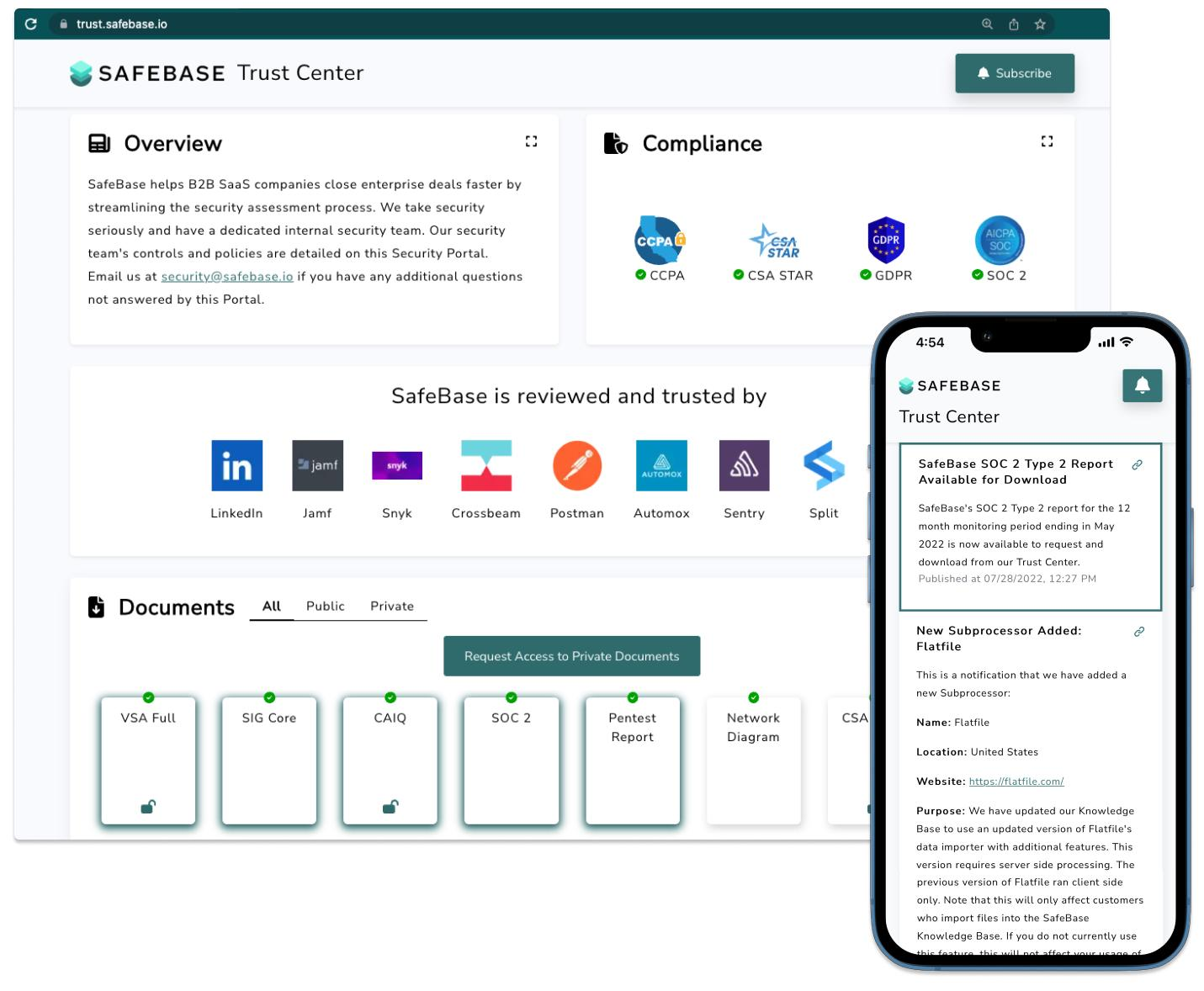
Core features include:
- Branded Trust Center: Publish certifications like SOC 2, ISO 27001, and security whitepapers
- Document management: Organize and share security information with optional NDA gating
- Access controls: Manage permissions for different users and document types
- Security questionnaire automation: Generate responses using your existing compliance documentation
- Continuous compliance monitoring: Track security controls in real time and maintain audit-ready documentation
- Analytics dashboards: Track document views and engagement
SafeBase by Drata is a strong fit for teams already invested in Drata's compliance platform who want to extend that into an external-facing trust portal. What it doesn't replace is the end-to-end agentic workflow that high-volume customer trust teams need. For lean teams managing hundreds of inbound security reviews across multiple products and geographies, the full-workflow automation gap shows up fast.
Vanta
Vanta is a compliance automation platform with an added Trust Center for sharing compliance artifacts externally.
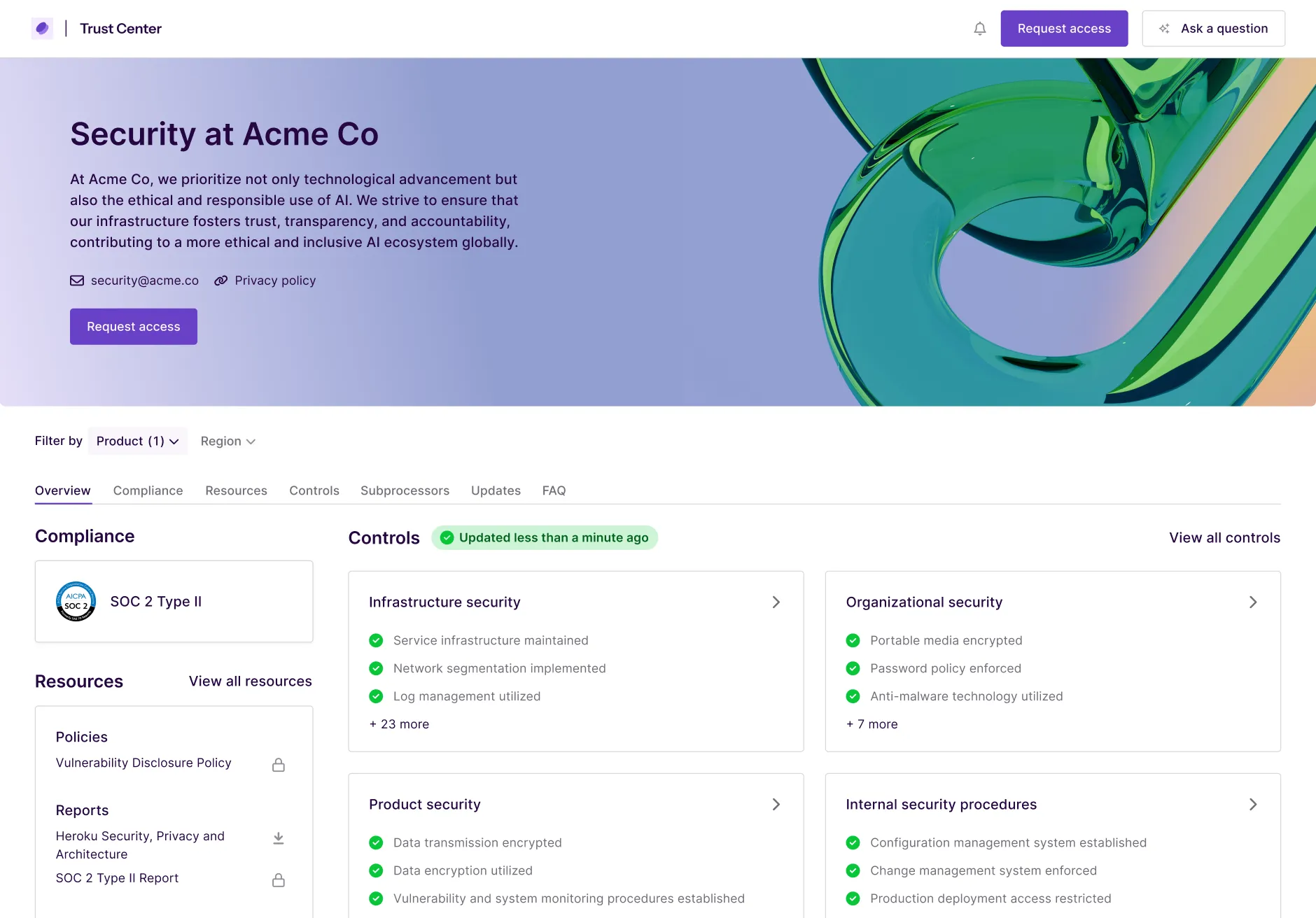
Key features include:
- Automated compliance publishing: Share SOC 2, ISO 27001, and penetration test results
- Compliance workflows: Align with major compliance frameworks and audit requirements
- Trust portal setup: Provide a simple, centralized hub for security documentation
Vanta is a strong option for companies prioritizing compliance automation looking to extend that into a basic Trust Center. For enterprise teams managing complex security reviews or large volumes of security questionnaires, the platform is less focused on automation and scalability within the review process itself.
Whistic
Whistic is primarily a third-party risk management (TPRM) platform that includes a Trust Center as one of its features. Its Trust Center, called the Whistic Profile, lets companies publish and share their security and compliance posture with prospects and customers.
Core features include:
- Security profile publishing: Centralize certifications, self-assessments, and compliance documentation in a shareable profile
- Knowledge base: Store and organize security and compliance documents with AI-powered smart search
- 40+ questionnaire frameworks: Self-assess against common industry frameworks and share responses in the formats customers need
- Salesforce and Slack integrations: Give sales teams the ability to share your security profile from tools they already use
- Trust Center Exchange: Publish your profile so prospects can conduct self-serve assessments without sending a questionnaire
Whistic works well for teams that want to proactively share security documentation and reduce inbound questionnaire volume through self-serve access. The core product is TPRM, assessing vendors not responding to customers. For customer trust teams managing high volumes of inbound security reviews at enterprise scale, the platform wasn't designed around that workflow.
Implementing your Trust Center software for maximum impact
Selecting the right platform is only half the equation. The real impact comes from how you roll it out across your workflows, sales teams, and security processes.
Start with a security documentation audit
Before you flip the switch, inventory what you actually have. Most teams uncover 15+ versions of the same document across Google Drive, Confluence, and local files. Consolidate SOC 2 reports, certifications, and security documentation into a single source of truth. This directly affects your AI accuracy and response quality.
Configure for your actual customer workflows
Map how prospects currently request security information. If most requests come through a shared inbox, route them to your Trust Center automatically. Connect Salesforce or HubSpot so activity syncs to the right deals and workflows.
Run a focused pilot first
Don't automate everything on day one. Choose one high-volume workflow like signing an NDA or letting the Trust Center Agent take a pass at customer questions, and run it through your Trust Center for two weeks. Measure response time and self-serve completion before expanding.
Train your sales team on the handoff, not the platform
Your sales team needs to know exactly one thing: when a prospect asks about security, send them this link. Create a simple one-pager with the Trust Center URL and what to do if a customer needs something beyond self-service.
Set metrics that connect to revenue
Measure what matters: response time to security requests, percentage of self-serve resolutions, and time deals spend in security review. When deals move faster with Trust Center engagement, you've shifted customer trust from operational overhead to a measurable revenue driver.
Maximizing your Trust Center software investment
Once you're live, the goal is to turn that platform into a measurable revenue driver rather than another SaaS line item.
Establish baseline metrics before optimizing
Start by capturing your current state. Track number of security questionnaires received, average response time, percentage of questions handled via self-service vs manual responses, and time deals spend in security review. These baselines give you a clear before-and-after story for leadership and make ROI visible.
Deepen CRM integration to connect trust with pipeline
If your Trust Center isn't fully integrated with Salesforce or HubSpot, you're missing the link to revenue. With proper integration, you can auto-approve access based on CRM fields, log prospect engagement automatically, trigger follow-ups based on document views, and surface Trust Center activity directly in deal workflows. This removes manual coordination and gives sales teams real-time visibility into the security evaluation stage.
Drive and monitor self-service adoption
Measure the percentage of requests resolved without human involvement each month. If most requests are still manual after rollout, the issue is usually gaps in your security documentation, difficulty navigating the Trust Center, or poor handoff from sales. Improving self-service rates is the fastest way to reduce workload and speed up the review process.
Tie Trust Center activity to revenue outcomes
The real value comes from connecting activity to impact. Modern platforms like Conveyor provide dashboards that show which prospects engage with your trust portal, what security information they access, and how that engagement correlates with deal progression.
When you can demonstrate that the same team handles more security reviews with faster responses and shorter sales cycles, you've repositioned customer trust as a revenue function, not operational overhead.
Every delayed security response is pipeline sitting still. When you automate customer security review workflows, you remove one of the biggest hidden blockers in your sales cycle.
If you want to see what that looks like with your own workflows, book a discovery call to see how Conveyor can turn your Trust Center into a revenue driver.
.png)