
Conveyor vs Vanta: Which Customer Trust Platform Is Right for You?
Ever feel like your customer trust team is handling more security reviews than ever with the same headcount? Chances are, they’re logging into multiple portals, copying answers across formats, chasing SMEs for the same security questionnaire responses, working the backlog of sales status update requests grow, and watching deals stall while the backlog grows.
Sound familiar? This isn’t an isolated problem. According to the Tines Voice of Security 2026 Report, 81% of teams say security workloads increased in 2025, yet they still spend 44% of their time on manual or repetitive work that could be automated. They’re weighed down by slow workflows and long sales cycles that lead to delays and poor customer relationships.
The thing is, not all platforms are built to solve the same problem. Vanta was made to help teams achieve and maintain compliance. Conveyor is built to automate the customer-facing security reviews that compliance work creates. Knowing which problem you're actually solving is the first step to picking the right tool.
Why customer trust teams are burning out on security automation
Most current solutions treat symptoms rather than the underlying problem. They offer better document sharing (but you're still manually updating those documents), basic questionnaire tools (but you're still reviewing every answer), and automation that usually means “we’ll pre-fill some answers and you handle the rest.”
The real issue isn’t that individual tasks are too slow. It’s that the entire workflow is fragmented, manual, and disconnected from revenue outcomes.
Sales teams lack visibility into where security reviews are stuck. Security teams don’t know which gaps are actually blocking deals. And trust teams are left trying to scale a process that doesn’t scale.
The questionnaire volume explosion
The challenge is that these workflow issues don’t exist in a vacuum, and review volume is accelerating the problem. In fact, According to the Conveyor’s 2024 State of Security Review, nearly 80% of leaders say handling increased review volume is now a top priority. In practice, enterprise companies see thousands of security questionnaires per year. And that’s before you factor in complexity.
What used to be a 50-question security questionnaire is now 200+, covering infrastructure, data privacy, AI governance, and third-party risk. Every new regulation, every high-profile breach, and every new AI feature adds more scrutiny.
In practice, this manifests as more inbound requests, longer review processes, and increasing pressure on already stretched security teams.
Why “good enough” automation still requires constant human oversight
The natural response to this problem is to automate. The trouble is, a tool is only as good as the knowledge behind it and that's where most platforms fall short. They rely on static Q&A pairs that have to be manually maintained. Every product update, every policy change, every new security control means someone has to go in and update the knowledge base by hand.
When your security posture shifts, the updates don't propagate. Answers go stale, reviews pile up, and your team is left catching errors that the tool should have caught leaving them right back to where they started.
.png)
So the same issues repeat:
- Answers need constant review
- Updates don’t propagate
- Knowledge stays fragmented across systems when you use multiple tools
This is why manual work persists. When questionnaire volume doubles, the work doesn’t disappear. It scales with it. And without a system that actually learns and adapts, the only way to keep up is by adding headcount.
Conveyor vs Vanta: fundamentally different approaches to trust
At a high level, Conveyor and Vanta aren’t a like-for-like comparison. That’s why it’s not about comparing features. It’s a workflow decision.
Simply put, they’re different animals. The distinction becomes clear in day-to-day use:
- Conveyor is built to streamline customer-facing security reviews by handling high-volume security reviews at scale.
- Vanta is designed to build and maintain compliance programs with additional add-ons for other GRC related workflows like Customer Trust.
There is overlap, such as security questionnaire automation, trust center, compliance framework support, but the intent is fundamentally different.
If your bottleneck is manual questionnaires, fragmented workflows, and stalled sales cycles, you need a platform built for that workflow, making Conveyor the better choice. If your priority is SOC 2, ISO 27001, and audit readiness, Vanta may be a stronger fit.
Conveyor's specialized customer trust automation
Conveyor is purpose-built for customer trust teams handling high volumes of security questionnaires.
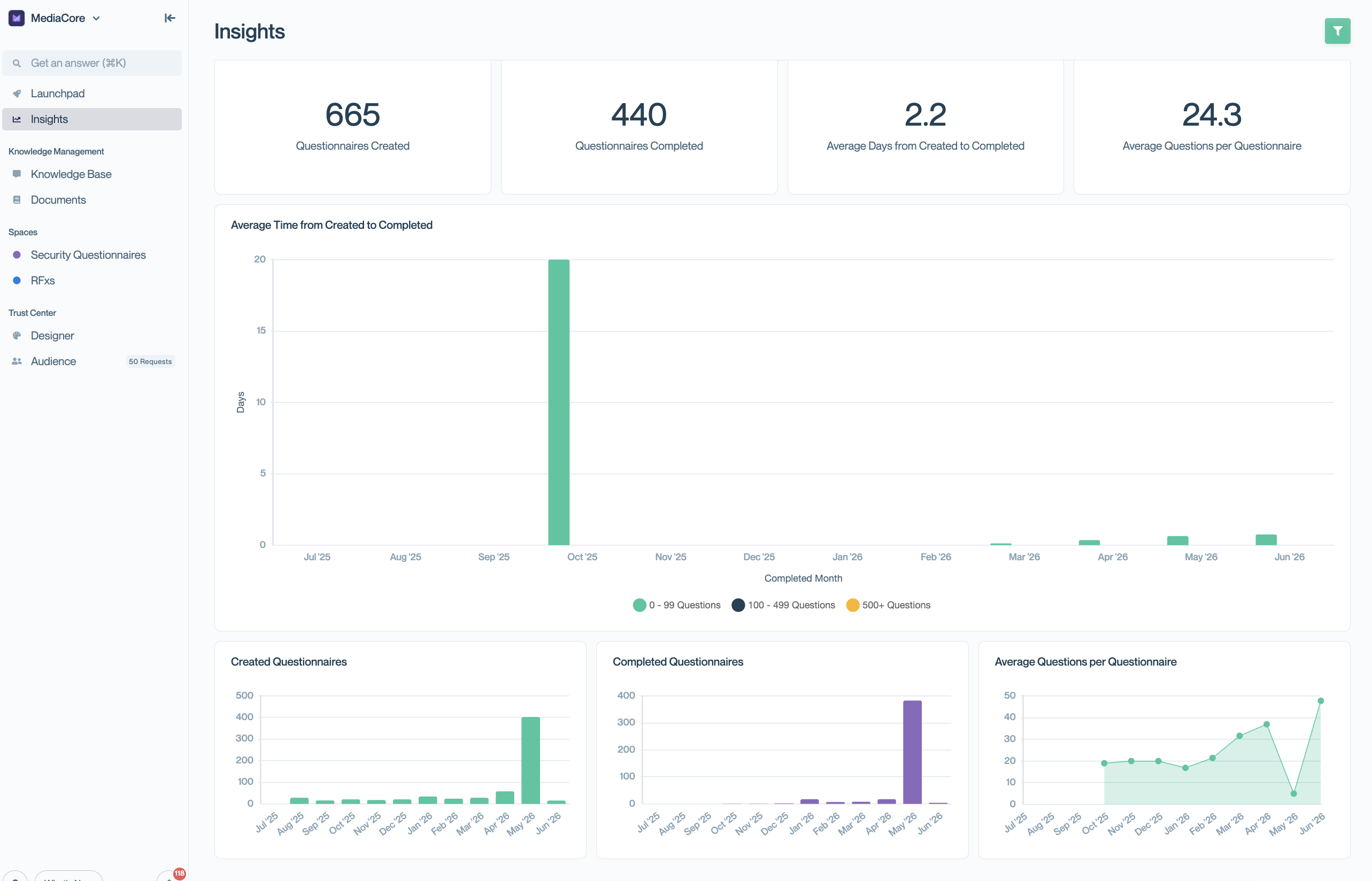
It focuses on speed, accuracy, and reducing manual work across the entire review process.
Key capabilities include:
- AI-powered questionnaire responses with 95%+ accuracy
- Self-healing knowledge base managed by AI Librarian that updates as your security posture changes
- Portal questionnaire automation across tools like OneTrust, Panorays, and many more portals
- Integrations to automate more of the workflow like granting access to a Trust Center through your CRM, giving sales the ability to get answers in Slack, and more
- Trust center automation and a Trust Center agent to help customers self-serve documents and info instantly
Everything is designed to reduce manual work and help security teams and sales teams move faster.
Vanta's comprehensive compliance management platform
Vanta is a compliance automation platform built to help teams achieve and maintain certifications.
It focuses on internal controls, audit readiness, and ongoing compliance management.

Key capabilities include:
- Continuous monitoring across systems like AWS, GitHub, and Google Workspace
- Automated evidence collection for SOC 2, ISO 27001, HIPAA, and GDPR
- Audit-ready reporting and dashboards
- Policy and access control management
- Vendor risk management and third-party tracking
Vanta also includes security questionnaire and trust center features, but these sit alongside its core GRC workflows.
Where Conveyor and Vanta actually compete (and where they don't)
On the surface, Conveyor and Vanta cover similar ground. Both automate security questionnaire responses, both offer a trust center, and both have invested in AI. For a team just getting started with customer trust workflows, either platform can move the needle.
The difference shows up when the work gets complex. Conveyor is built around customer-facing trust workflows as every part of the platform exists to handle security reviews at scale. For Vanta, questionnaire automation and trust center sit alongside compliance, audit, and risk management. Customer trust is part of the platform. For Conveyor, it's the whole platform.
That distinction matters more as your organization scales.
Conveyor is built for:
- High-volume security reviews
- Complex org structures with multiple products, regions, and entities to handle in a Trust Center
- Conditional answers that change based on customer profile, geography, or product line
- Enterprise workflows connecting legal, sales, and security stakeholders with deep CRM and Slack or other tool integration
- A Trust Center Agent that lets prospects get questionnaires completed directly, without waiting on your team
Vanta is built for:
- Startups and mid-market teams
- SOC 2, ISO 27001, and compliance management
- Simpler use cases with lower questionnaire volume
The distinction matters more as review volume grows. What worked for a 100-person company managing a handful of security questionnaires doesn't hold up when you're handling hundreds of security reviews across regions, products, and customers.
In practice, that means:
- More manual work: Teams spend more time editing AI-generated answers, handling edge cases, and managing exceptions the system can't handle
- More fragmented workflows: Security, Legal, and Sales operate in silos with no shared visibility, slowing down sales cycles
- More reliance on spreadsheets and subject matter experts: Complex responses still get pulled from Slack threads and docs instead of a reliable, self-healing knowledge base
The result is a slower review process, inconsistent answers, and increasing pressure on already stretched security teams. Vanta works well for startups building compliance programs. But if you're handling customer trust workflows at scale, Conveyor is built for that problem specifically.
Making the choice: when to pick Conveyor vs Vanta
The decision comes down to the problem you need to solve.
If your biggest blocker is customer-facing security reviews — questionnaires stalling deals, trust teams buried in portal work, and prospects asking the same questions across formats — you need to choose a platform built for trust workflows.
If you're building compliance programs from scratch and need internal controls, audits, and certifications, you're solving a different problem.
Choose Conveyor when:
- Your team handles 30+ security questionnaires monthly, and volume is actively blocking revenue
- You already have SOC 2, ISO 27001, or similar certifications, but customer trust workflows are still manual
- Portal work is consuming time across security teams and sales teams
- You need to streamline security reviews and reduce repetitive manual work
- You're operating in a complex environment where answers depend on product, region, or customer context
Conveyor is designed to automate customer trust workflows, improve accuracy, and reduce friction across the entire review process.
Choose Vanta when:
- You're building compliance programs from the ground up
- Lower security questionnaire volume (under 20 per month)
- Your priority is SOC 2, ISO 27001, GDPR, and internal compliance management
- You need strong evidence collection, policy management, and audit readiness
Vanta is designed to support compliance automation and internal security programs.
Here’s the bottom line. Most teams aren’t choosing between Conveyor vs Vanta in isolation. They’re deciding which problem to solve first.
- A 3-person infosec team handling 50+ questionnaires monthly needs to fix security review bottlenecks immediately
- A startup building its first SOC 2 program needs compliance infrastructure first
As teams grow, many end up using both tools. They use Vanta for compliance management, and Conveyor to handle customer-facing security reviews at scale.
If security reviews are slowing your sales cycles, you need a platform built for that stage of the process. Explore how Conveyor helps teams streamline customer trust workflows, from questionnaires to trust centers to approvals. Book a discovery call today.
.png)