
Security questionnaires have a way of consuming more time than anyone plans for. Most GRC and information security teams still manage intake, routing, answer generation, reviews, and follow-ups manually, while sales teams are waiting on answers to keep enterprise deals moving.
AI agents for security questionnaires are the first viable way to automate that entire process without sacrificing accuracy or control. Rather than handling one isolated task, they manage complete questionnaire workflows, freeing security teams up for work that actually requires their expertise.
What are AI agents for security questionnaires?
AI agents for security questionnaires are software systems powered by LLMs that manage the full questionnaire workflow from intake through final review, rather than automating one isolated task.
Traditional automation tools usually handle only one part of the process, like answer generation. Most solutions today generate responses but leave teams managing intake, completing portal questionnaires, and handling knowledge maintenance and exporting themselves. AI agents handle the full chain — ingesting requests and triaging tickets, communicating with requestors, parsing questions, generating responses, routing reviews to the right SMEs, and exporting completed questionnaires back to your CRM — without your team coordinating every handoff.
But automating the workflow is only half the picture. The other half is keeping the knowledge behind those responses accurate. Most security questionnaire tools rely on static answer libraries that quickly become outdated. Platforms like Conveyor connect directly to approved documentation, external sites, and company wikis to generate responses while automatically identifying outdated answers, duplicate content, and gaps in coverage.
How AI agents transform security questionnaire workflows
Here's what that looks like in practice, across each stage of the review process:
Intake and triage security questionnaire requests automatically
Most teams ingest sales requests for customer security reviews from Slack, email, ticketing systems, or CRM platforms. Before anyone answers a question, they're already losing time to validating files, chasing missing information, assigning ownership, and posting manual status updates.
AI agents automate that intake process by:
- Monitoring intake channels — Slack, email, Jira tickets, and Salesforce cases
- Validating file formats and required metadata
- Rejecting incomplete requests automatically
- Completing questionnaires based on rules like deal size or number of questions
- Posting status updates back into the original system
This enables your team to spend less time coordinating requests and more time reviewing actual responses.
Generate first-draft answers from approved knowledge sources
AI agents parse questions across spreadsheets, portals, PDFs, and documents. The agent identifies what's being asked and generates AI-powered responses from approved knowledge sources like:
- SOC 2 reports
- Security policies
- Trust center documents
- External sites like support sites and websites
- Internal wikis like Notion, Confluence, and more
- Documents in Google shared drives
- Previous questionnaire responses
- Compliance records
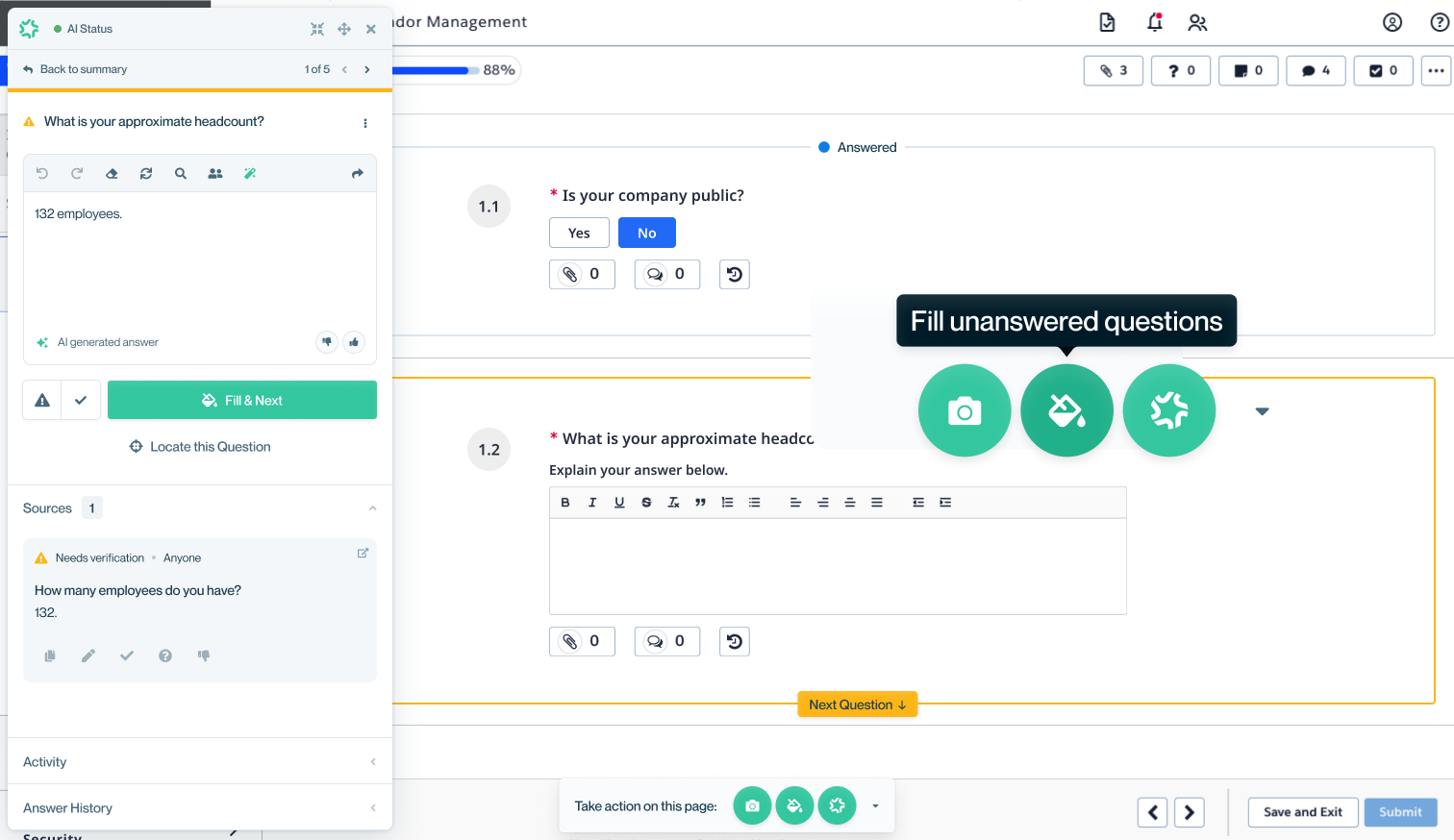
The agent can autofill portal responses and preserve formatting across file-based questionnaires — removing the copy-paste cycle that slows down most security questionnaire workflows.
Route low-confidence answers to the right collaborators
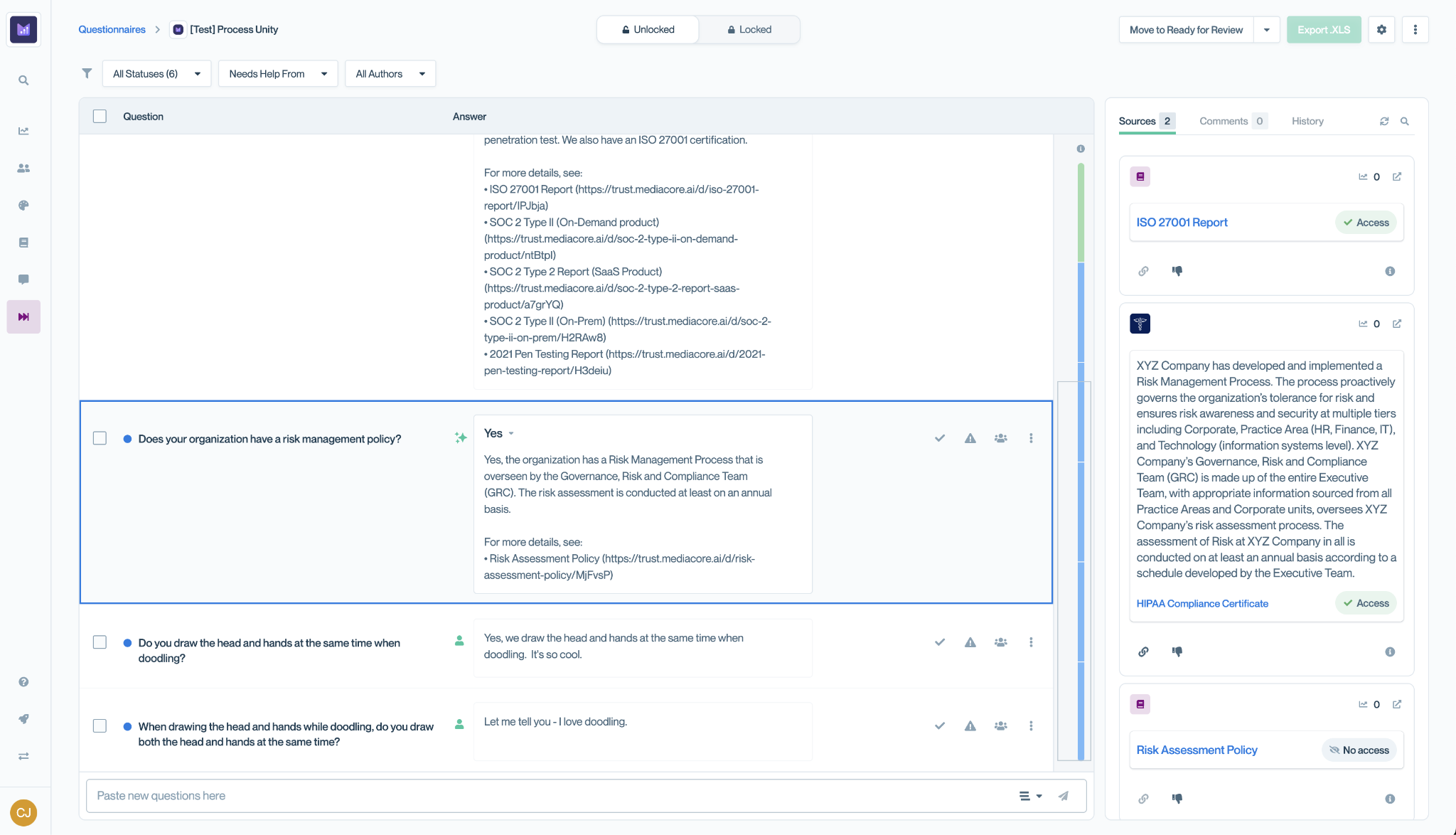
Not every answer should be approved automatically. AI agents route low-confidence or high-risk answers for human review using confidence scores and workflow rules. Depending on the question type, the agent routes to the right people automatically:
- SOC 2 questions route to compliance teams
- Infrastructure questions route to security engineering
- Privacy questions route to the Legal team
Reviewers receive proposed answers, source documents, and confidence scores directly in Slack, email, or ticketing systems — so your team spends time on exceptions, not on answering every question from scratch.
Export, submit, and close the loop
Once your team approves responses, the agent exports completed questionnaires back into the original format or system, or submits answers directly into vendor portals. The system also:
- Updates Jira, Zendesk, Salesforce, or Front tickets
- Syncs records back into Salesforce
- Notifies sales teams automatically
- Attaches completed questionnaires to CRM tickets
This reduces manual effort and shortens response time across the full review process.
Improve the knowledge library after every questionnaire
Most security questionnaire tools rely on static answer libraries that become outdated over time. AI agents focus on updating the knowledge base after every completed security review by:
- Identifying duplicate responses
- Flagging outdated information
- Detecting gaps in coverage
- Recommending stronger approved answers
This means that your knowledge base stays accurate without additional maintenance work.
Key features to look for in AI security questionnaire agents
When evaluating AI security questionnaire tools, the most important question isn't whether a platform uses AI — it's how much of the workflow it actually automates. Most tools handle one or two steps and leave your team coordinating the rest. Here's what separates enterprise-grade agents from basic automation.
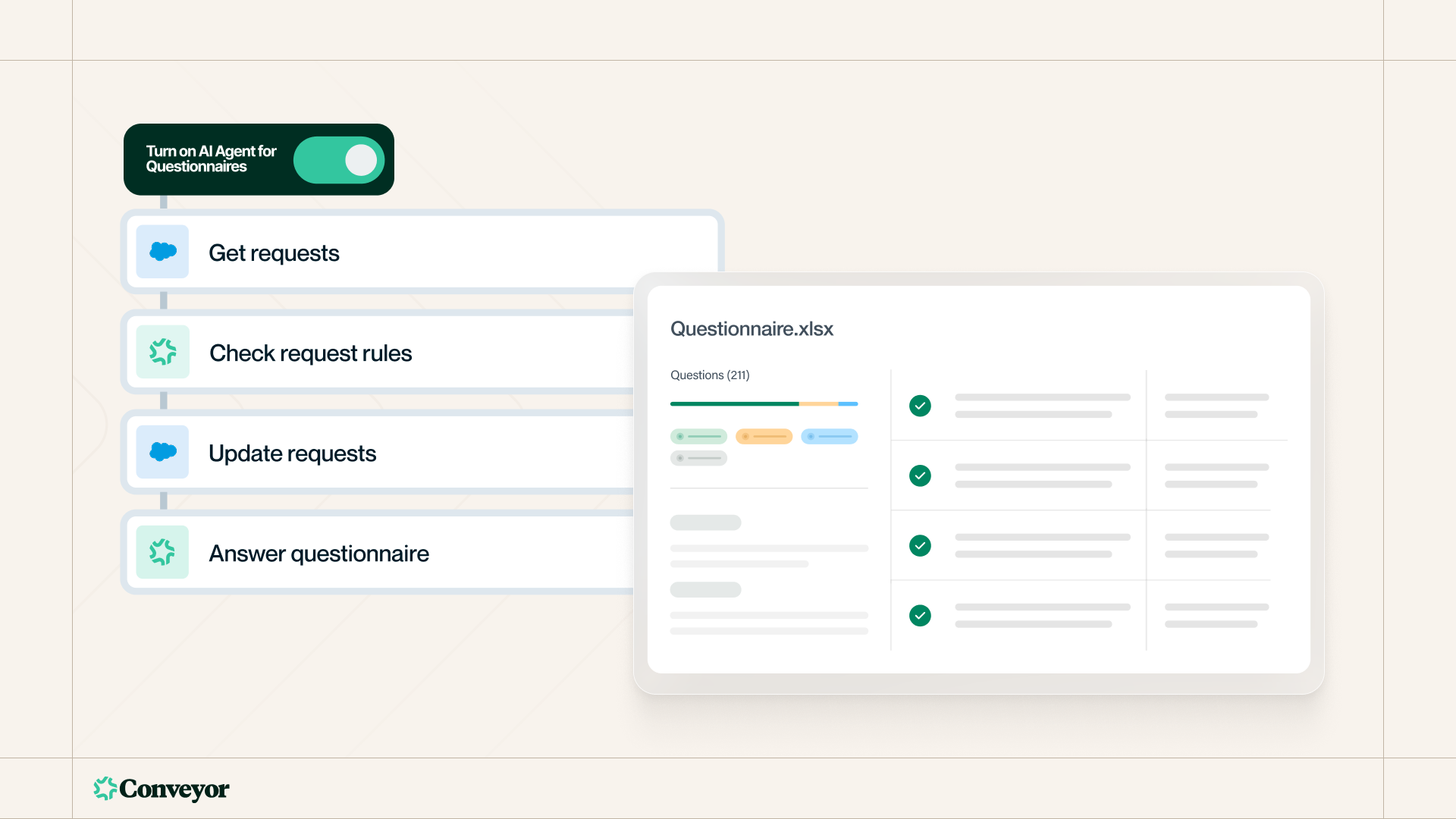
Automated request intake and rules-based triage
Look for a platform that lets you define your own routing rules — by deal size, risk level, question category, or requestor — rather than applying a one-size-fits-all intake process. The system should handle validation and rejection of incomplete requests automatically, and post status updates back into whatever system the request came from. Without configurable rules, your team ends up making manual routing decisions that the platform should be making for them.
Rules-based triage should support workflows like:
- Escalating high-risk questionnaires automatically
- Routing reviews by question category
- Auto-completing low-risk questionnaires
- Posting updates back into Jira, Salesforce, or ServiceNow
Accurate question parsing across spreadsheets, documents, and portals
Security questionnaires don't arrive in a standard format. Your AI agent needs to handle spreadsheets, PDFs, Word documents, and third party portals. It also needs to understand the conditional logic within each of them.
A strong parsing system should also recognize situations where:
- A question depends on a previous response
- Multiple rows refer to the same security control
- Portal field labels map to existing approved answers
Unlike generic AI tools, which often struggle with this level of parsing accuracy, Conveyor reports 95%+ answer accuracy. That’s because the platform is built specifically for security reviews and questionnaire workflows, and trained on this context rather than general-purpose AI output.
Knowledge base integration and management
Look for a platform that connects directly to your existing documentation rather than requiring you to manually maintain thousands of Q&A pairs. The system should pull from approved sources — certifications, external sites, support sites, shared drives, company wikis, trust center content, previous responses — and keep them current as your security posture changes.
The system should also identify duplicate answers, outdated information, conflicting responses, and missing coverage automatically without your team having to audit the knowledge base manually.
Confidence-aware review and human-in-the-loop controls
Enterprise teams still need human oversight for sensitive or high-risk responses. AI agents should use confidence scores and workflow rules to determine which answers require review. A confidence-aware review process should support workflows like:
- Routing low-confidence responses to SMEs automatically
- Moving high-confidence responses through review workflows faster
These controls help your team maintain accuracy without manually reviewing every answer.
Source-grounded answer generation
Your team should be able to see exactly which sources the agent used for every response. According to Darktrace's 2026 State of AI Cybersecurity report, 77% of organizations already use generative AI somewhere in their cybersecurity workflows. But many generic AI tools generate answers without reliable source validation or audit trails. Look for a platform that ties every response directly to approved documentation like SOC 2 reports, security policies, architecture diagrams, and penetration test results.
Top AI agents for security questionnaire automation
Most platforms focus on different parts of the security review process. The biggest differences come down to workflow automation, parsing accuracy, portal support, and knowledge base management.
Conveyor
Conveyor is an AI-native platform built to automate the entire security questionnaire workflow — from intake through final submission — not just the question-answering.
Features:
- AI-native security questionnaire automation: Conveyor handles the full workflow including answer generation, review routing, portal autofill, and export
- Integrations with CRMs and ticketing systems (Salesforce, HubSpot, Zendesk, Jira, Front, Slack, and more): AI Agent automatically picks up requests, triages and completes questionnaires based on rules, communicates with requestors, and exports final documents back to the system
- Question parsing across spreadsheets, portals, and documents: The platform reads questionnaire structure and conditional logic across every format
- AI-generated responses tied to approved documentation: Every answer is generated from approved knowledge sources and linked to a cited source document
- Review routing and human oversight workflows: Low-confidence or high-risk answers are automatically routed to the right reviewer
- Portal autofill: The platform autofills portal questionnaires directly
- Knowledge base maintenance and updates: Conveyor connects directly to live knowledge sources instead of static answer libraries, identifying duplicate answers, outdated information, and gaps automatically
Cons: Conveyor is purpose-built for customer-facing trust workflows. Teams that haven't yet established a GRC compliance foundation will want to do that first to get the most out of the platform.
Vanta
Vanta includes questionnaire automation as part of its broader compliance and trust management platform, supporting AI-assisted responses, trust center workflows, and integrations with existing compliance documentation. Unlike Conveyor, which automates the entire security questionnaire workflow end-to-end, questionnaire automation is one part of a much larger GRC platform.
[PLACEHOLDER: Vanta product screenshot]
Pros:
- Strong fit for teams building or maintaining SOC 2, ISO 27001, and HIPAA compliance programs.
- Centralizes compliance operations for teams already using Vanta for GRC.
- Well-established platform with a large integration ecosystem across infrastructure and developer tools.
Cons:
- Questionnaire automation and trust center are not Vanta's core product. Teams that rely heavily on these workflows may find feature development lags behind platforms where customer trust is the primary focus
- Built primarily for SMB compliance programs, Vanta may lack the enterprise-grade features (like multi-product support, advanced roles and permissions, or portal automation) that larger, complex security review teams need.
Drata
Drata approaches security questionnaires through its larger compliance automation platform, supporting AI-generated responses, trust center integrations, workflow approvals, and compliance documentation management.
[PLACEHOLDER: Drata product screenshot]
Pros:
- Strong continuous monitoring across cloud infrastructure, with automated evidence collection
- Good fit for teams that want compliance management and questionnaire support in one platform
- Integrates well with developer and engineering tooling like GitHub, AWS, and Google Workspace
Cons:
- Questionnaire workflows are embedded within broader GRC operations, which may limit flexibility for teams focused on high-volume enterprise security reviews.
Loopio
Loopio was originally built for RFP and proposal management. Many organizations still use it for questionnaires when security reviews are handled alongside broader procurement and proposal workflows.
[PLACEHOLDER: Loopio product screenshot]
Pros:
- Strong fit for teams managing RFP and proposal workflows
- Established answer library for structured human review workflows
- Strong project management and collaboration features, with the ability to assign questions to SMEs, set up multi-step review workflows, and manage permissions across contributors.
Cons:
- Answer libraries based on Q&A pairs require manual maintenance and don't update automatically as your security posture changes.
- Answer generation relies on surfacing content from a maintained library rather than reasoning across your full security posture, which can limit accuracy for complex or nuanced security questions compared to AI-native platforms
- Less emphasis on security-specific parsing, portal automation, and confidence scoring than AI-native platforms.
Implementing AI agents for security questionnaires
Most organizations start with a phased, focused rollout before expanding AI automation across broader security questionnaire workflows:
Document your baseline metrics
Before you start, capture where things stand today. Track metrics like:
- Average response time per questionnaire
- Hours spent per questionnaire
- Number of review cycles
- Back-and-forth communication with requesters
These benchmarks make it easier to measure ROI once the platform is up and running.
Configure knowledge sources and review workflows
Connect the AI agent to approved documentation that reflects your current security posture. That means linking to external sources like your trust center, support sites, and company wikis, uploading recently completed questionnaires as reference, and connecting to shared drives, Notion, Confluence, or wherever your security documentation lives.
The stronger your knowledge foundation at the start, the more accurate your answers will be from day one.
Run your first questionnaires and check accuracy
Start running questionnaires through the platform. Review confidence scores and check answer accuracy closely in these early stages. Flag any gaps in your knowledge sources and adjust your review rules as needed. For example, routing low-confidence answers to the right SME or escalating specific question categories to infosec or compliance leads.
Expand into touchless workflows
Once your team trusts the review process and confidence scoring, you can automate more of the operational workflow for lower-risk questionnaires.
That can include:
- Intake and triage
- Answer generation
- Portal uploads
- Requester updates
- SME routing
- CRM and ticketing updates
According to PwC’s AI Agent Survey, 66% of organizations using AI agents report faster decision-making. For security reviews, that can mean shorter turnaround times and fewer delays during enterprise sales cycles.
Monitor accuracy and maintain oversight
Human oversight still matters, especially for sensitive security responses and regulated industries. Let Conveyor's AI librarian handle ongoing knowledge maintenance, which scans for gaps and duplicates, and tags the right people in to update answers as your security posture changes. You can also track AI accuracy performance metrics directly in the platform, so you always have visibility into how your AI is performing.
Platforms like Conveyor are built for this phased approach, helping teams automate security questionnaire workflows without losing visibility, accuracy, or control. Explore how AI agents can streamline your security questionnaires and save you from the headache. See what Conveyor’s platform can do for you — book a discovery call with our team.
.png)