-p-1600.avif)
Your security team is already operating at capacity, and compliance work is a major driver. A 2025 Sophos survey found that nearly 40% of IT and cybersecurity team time is spent on compliance-related activities. Layer on security questionnaires, certification updates, managing sales questions, and Trust Center updates, and these customer trust workflows quickly dominate your team’s workload.
While analysts move between spreadsheets, email threads, and portals, deals stall waiting for security review. This directly impacts revenue and your ability to build customer relationships and customer loyalty at scale.
A strong customer trust software business case doesn’t just reduce manual work. It removes friction from the customer journeys, accelerates purchasing decisions, and creates a clear competitive advantage by helping your team establish trust faster than competitors — turning security into a driver of business growth, not a bottleneck.
Why customer trust software matters for enterprise security
Security teams handle more reviews every quarter, with the same headcount. As enterprise buyers raise the bar on vendor scrutiny — driven by AI adoption, expanding regulatory requirements, and higher-stakes procurement processes — the volume of inbound security requests keeps climbing. Manual workflows can't absorb that growth. They fragment across tools and teams, leading to slow responses, inconsistent answers, and poor visibility into where every request stands.
This is because workflows don’t scale. They fragment across tools and teams, leading to slow responses, inconsistent answers, and poor visibility across customer data and trust workflows.
The hidden costs of manual trust workflows
Manual trust workflows break down because work is spread across tools and teams without consistent control.
In practice, that shows up in three ways:
- Fragmented ownership slows response times: When answers sit across systems and teams, every request needs coordination. The more people involved, the slower the process becomes. Gartner reports enterprise deals involve five to 11 stakeholders, which means more handoffs, more follow-ups, and more delays.
- No centralized knowledge base creates constant rework: When security knowledge is scattered across Google Drive, Confluence, and old questionnaire files, there's no single source of truth to build from. That means conflicting answers across deals, time lost waiting on other teams to confirm what's still current, and the same questions getting re-answered from scratch every time, affecting customer trust.
- Manual effort reduces visibility and control: Beyond answering questionnaires, teams absorb a constant stream of admin work — triaging security request tickets, giving sales teams status updates, granting Trust Center access, sending documents over email, and coordinating handoffs across teams. None of it is strategic. All of it takes time.
Altogether, this manifests as slower responses, higher error risk, and weaker consumer trust in your security communications.
Security team burnout and resource constraints
Security teams handle compliance, incident response, governance, and customer trust workflows at the same time. The work taking the most time is often the least strategic, and that’s only going up.
According to Thomson Reuters, 73% of compliance leaders expect regulatory activity to increase, adding more reviews and documentation. Simultaneously, workforce shortages mean fewer people are available, so teams absorb more work with the same capacity.
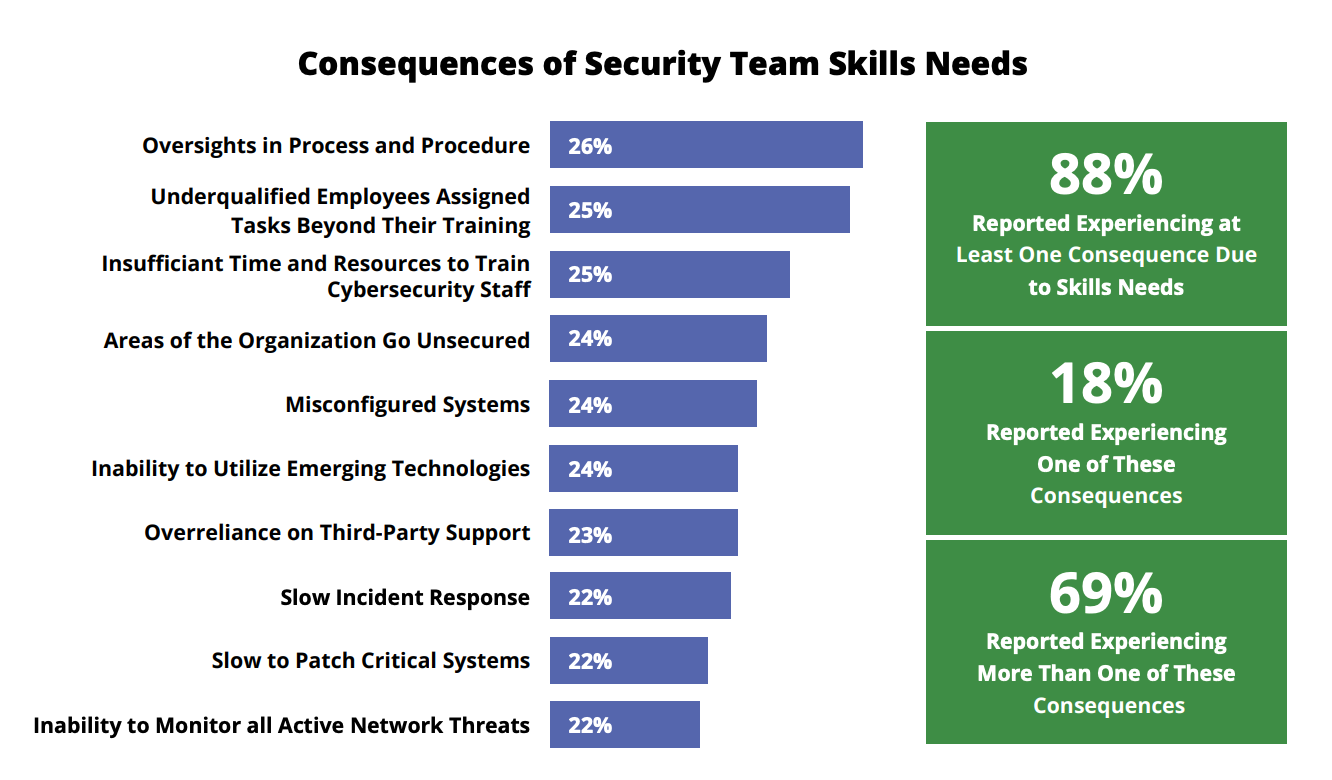
That trade-off creates risk. Time spent on repetitive questionnaires takes away from proactive security work and increases exposure to data breaches. ISC2’s 2025 Cybersecurity Workforce Study found that in 26% of teams, skills gaps lead to process oversights. Worse still, in 24%, these skill shortages leave parts of the organization unsecured.
Revenue impact of delayed security reviews
Security reviews sit directly in your pipeline. Foundry’s B2B Tech Buying Playbook highlights that 79% of B2B SaaS buyers are more likely to engage with vendors they trust, but slow responses weaken customer confidence during evaluation.
The report also found that nearly 40% of buying decisions stall early in the process. As security reviews often exist in that stage, delays here have an outsized impact. This creates real commercial risk as deals lose urgency and buyers shift their attention, increasing churn risk during long evaluation cycles. Competitors with faster, more structured trust workflows move ahead.
Building the financial case for customer trust software
Every delayed response, manual follow-up, and repeated questionnaire adds cost and erodes business value. To build the case for onboarding a new customer trust software, start by quantifying these costs, then show what happens when you remove them.
Calculating ROI from trust infrastructure automation
To show the return on investing in customer trust software, your first step should be to separate three things:
- Current cost = analyst time + deal delays + coordination overhead
- Future cost = reduced manual effort after automation (typically 80%)
- Investment = platform cost
From there:
- Annual cost savings = Current cost – Future cost
- ROI = (Annual cost savings – Platform Cost) ÷ Investment x 100

Here’s an example in action:
Your team handles 50 questionnaires per month, each taking 8 hours, at a $85/hour fully loaded cost. That’s roughly $408,000 per year in analyst time.
Add ~25% for coordination overhead (reviews, follow-ups, SME input), and your total current cost is closer to $510,000 per year.
While these aren’t fixed numbers, they are a simple example of how to model your current state based on your own volumes and costs.
Next, apply Conveyor’s typical results:
- 80% reduction in manual effort
- 90% faster turnaround times
That brings your manual workload down to roughly $102,000 per year.
Here’s how you work out your ROI from your savings:
- Cost savings ≈ of $408,000 per year
- Subtract your platform investment to get your net gain
- Divide by the platform investment x 100 to calculate ROI
This shows how much return you generate for every dollar spent. For most teams using Conveyor, that gap between current cost and automated cost covers the investment quickly, with ROI typically achieved within 90 days.
Cost analysis of security review bottlenecks
Manual workflows create significant delays in security reviews, which directly affects pipeline performance. However, automation reduces such delays by speeding up responses and removing coordination bottlenecks, keeping deals moving forward.
To quantify how that happens, start by measuring:
- Average deal value
- Average delay caused by security reviews
For example, if your average deal is $100,000 and security reviews delay deals by 3–5 days, that slows revenue recognition across your pipeline. Now apply that across volume:
- 20 deals in pipeline
- 3–5 day delay per deal
That’s 60–100 days of cumulative delay across active revenue, during which time revenue can shift into later quarters, and deals can lose urgency.
Measuring the impact of faster deal cycles
A key metric to track is how quickly your deals are going through, and how they impact your bottom line across your pipeline. To do that, look at:
- Time needed to complete security reviews
- Total deal cycle length
- Time spent in the “security review” stage
Then compare performance before and after automation. You’ll quickly see how even small improvements have a clear impact.
Key components of a robust customer trust software business case
A strong business case needs to show three things: fast impact, measurable efficiency, and competitive advantage. These are the levers executive teams use to approve investment.
A high-impact, low-risk AI use case
Customer trust workflows are one of the lowest-risk ways to apply AI in security. That’s because the work is repetitive, well-documented, and already based on approved materials and existing customer data like SOC 2 reports, security policies, and compliance documentation. AI doesn’t need to make new decisions. It just needs to pull from what already exists.
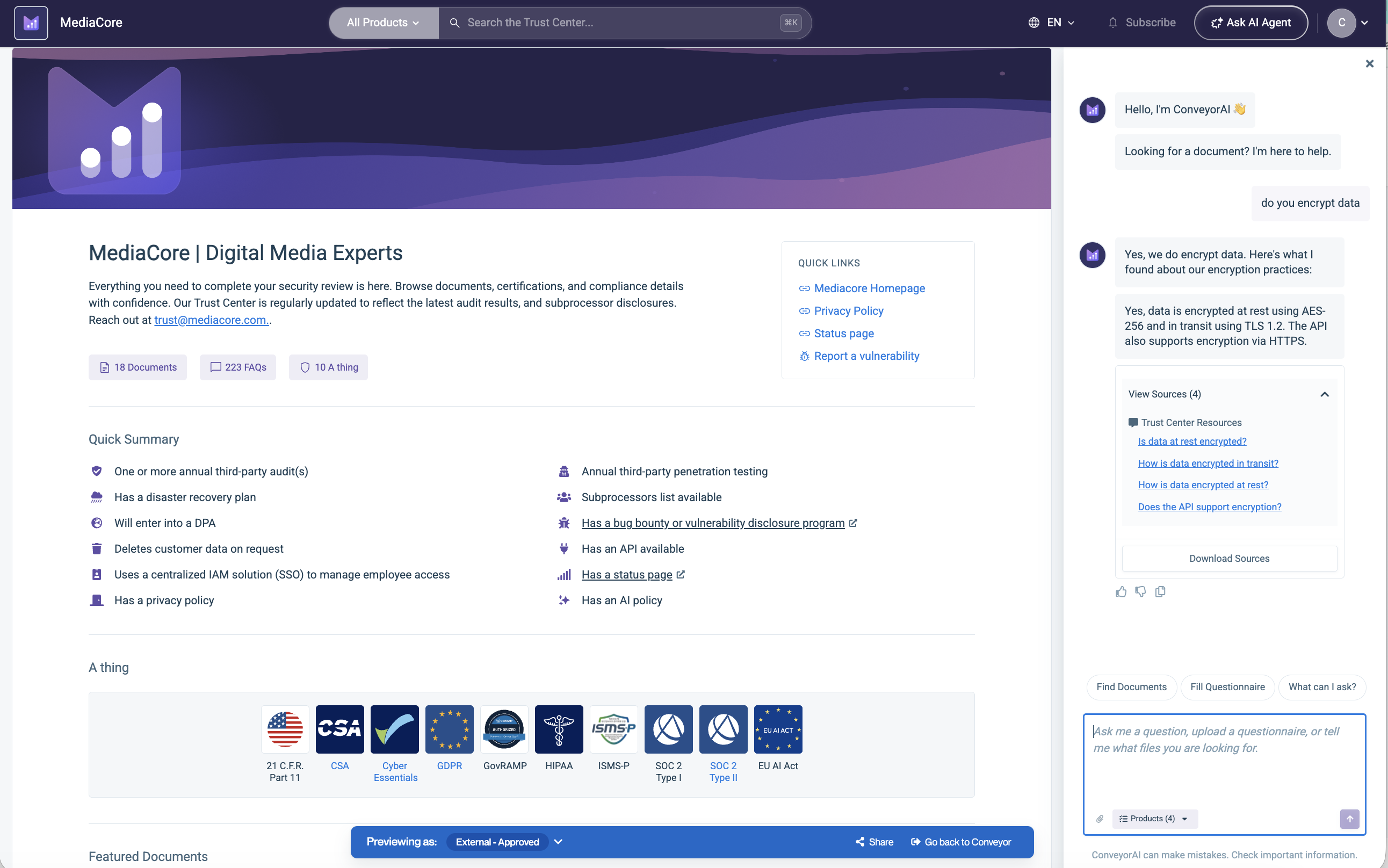
The system generates draft responses using that documentation, and your team reviews and approves everything before it’s shared. That keeps the use case controlled and auditable, while still delivering immediate operational impact.
This is where platforms like Conveyor come in. By structuring that workflow end-to-end, they remove manual effort while improving functionality and control. This has resulted in:
- 80% reduction in manual effort
- 90% faster turnaround times
- 95%+ accuracy based on approved documentation
Operational efficiency and team productivity gains
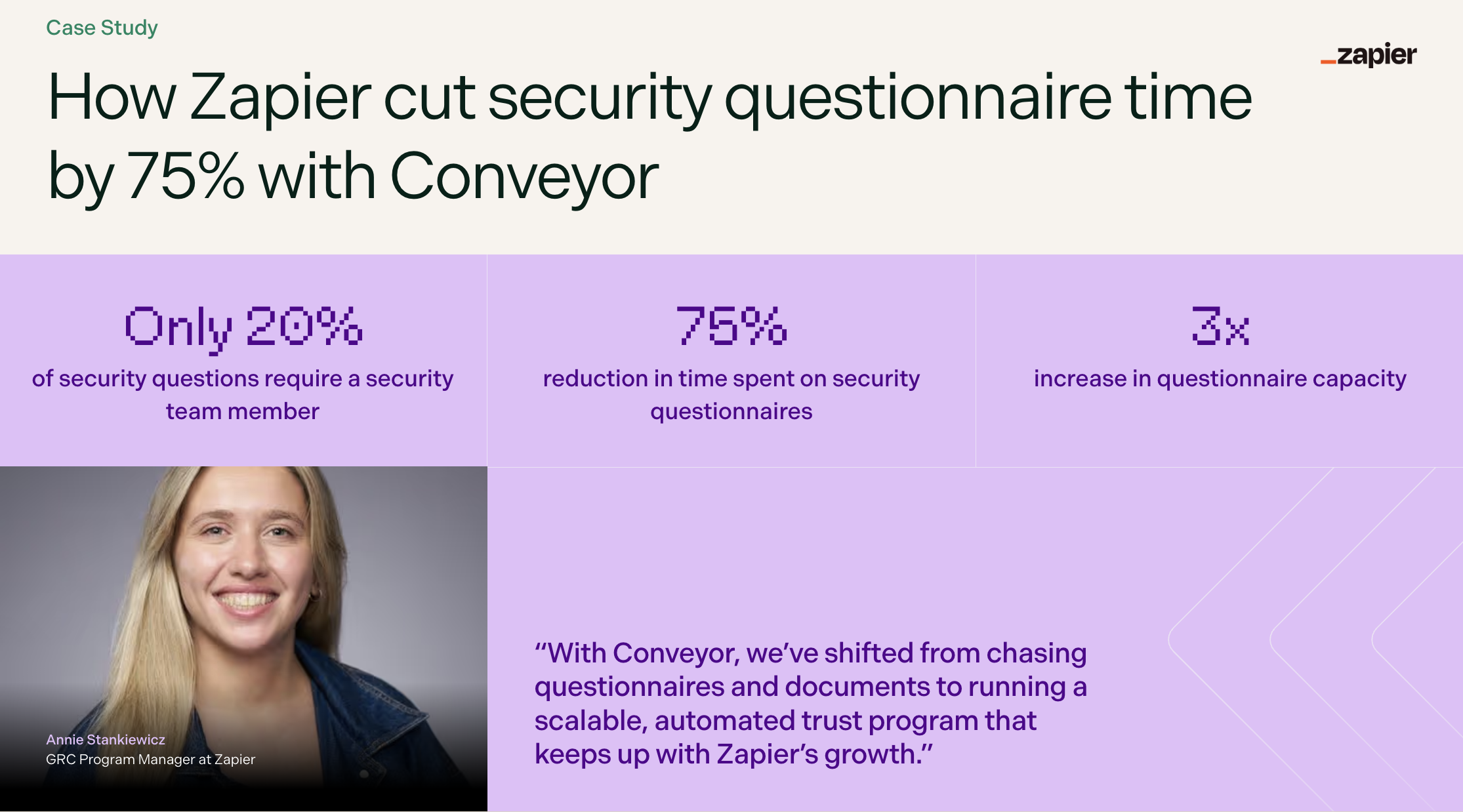
One of the biggest disadvantages of manual customer trust workflows is that they spread work across multiple teams and customer touchpoints. Security handles responses, GRC reviews for compliance, Sales follows up with customers, and subject matter experts get pulled in for specific questions. Each step adds coordination and handoffs, and a substantial amount of time is spent managing this process, instead of answering questions.
Automation removes that coordination layer. Responses are generated from approved documentation and routed to the right reviewers, with real-time tracking in one place. Instead of chasing inputs, your team can focus on higher-value activities like threat detection, architecture improvements, and proactive security work. In practice, teams see a significant reduction in manual effort and far less reliance on senior staff for reviews. Work becomes more consistent, simpler to manage, and easier to scale across the full customer lifecycle.
Competitive advantage through faster trust building
Speed shapes how buyers experience your business. Most enterprise deals involve multiple vendors in evaluation at once. The security review stage is where a lot of that competition plays out, with buyers noticing which vendors respond in hours versus days. Those signals shape perception before a final decision gets made.
Sumo Logic saw this directly. After deploying Conveyor, they delivered security information 82% faster during the sales cycle. Speed at that stage indicates that your security program is mature and worth trusting. It also denotes a team that isn't buried in manual reviews can support more deals or product lines without adding headcount.
Presenting your business case to executive leadership
Once you’ve quantified ROI, translate it into outcomes stakeholders care about, like business value, pricing efficiency, and growth.
Crafting your pitch for different stakeholders
Each decision-maker has different priorities, so you need to tailor the above data toward their area of focus.
For the CFO, think about ROI. They’re looking at the cost today vs cost after automation. Lead with what you're currently spending on manual reviews, not what the software costs.
For the CRO, they’re looking for speed to create momentum so it drives revenue. They care about pipeline, not process. Frame it as a sales problem: deals are stalling at the security review stage, and that's a revenue timing issue, not an IT issue. They'll engage with that faster than any efficiency metric.
Finally, for the CEO, focus on strategy and positioning. Look at the competitive angle: buyers are evaluating multiple vendors simultaneously. Faster, consistent responses make us easier to buy from, improve onboarding, and help us respond to customer needs faster. This shifts security from a blocker to a competitive advantage.
Addressing common objections and security concerns
Expect pushback and address it directly with clear answers. Ahead of any conversation, arm yourself with data that tracks things like time to respond, hours spent, review cycles, and customer feedback. This will make it easier to validate the business case with your own results.
Get ready to answer questions like:
- Q: How do we know the AI won’t generate incorrect responses?
A: Responses are generated from approved documentation (SOC 2 reports, security policies, certifications). Human review remains in place before anything is shared.
- Q: How complex is implementation?
A: The platform integrates with existing systems, including CRMs, document repositories, and ticketing platforms. Most teams complete initial rollout in weeks, not months.
- Q: Do we lose control over our data or workflows?
A: Responses are generated from approved sources, and review and approval workflows stay fully under the company’s control.
If there’s still hesitation, suggest a pilot to remove the guesswork.
Implementing customer trust software successfully
Once you’ve secured buy-in, the next step is to prove value quickly without disrupting live deals. Here’s a step-by-step implementation plan to ease rollout:
- Start with a focused pilot: Pick 2–3 high-volume security questionnaire types or a single customer portal causing the most friction. This gives you a controlled environment to validate accuracy, refine responses, and build confidence with stakeholders. Most teams see measurable time savings within the first 30 days.
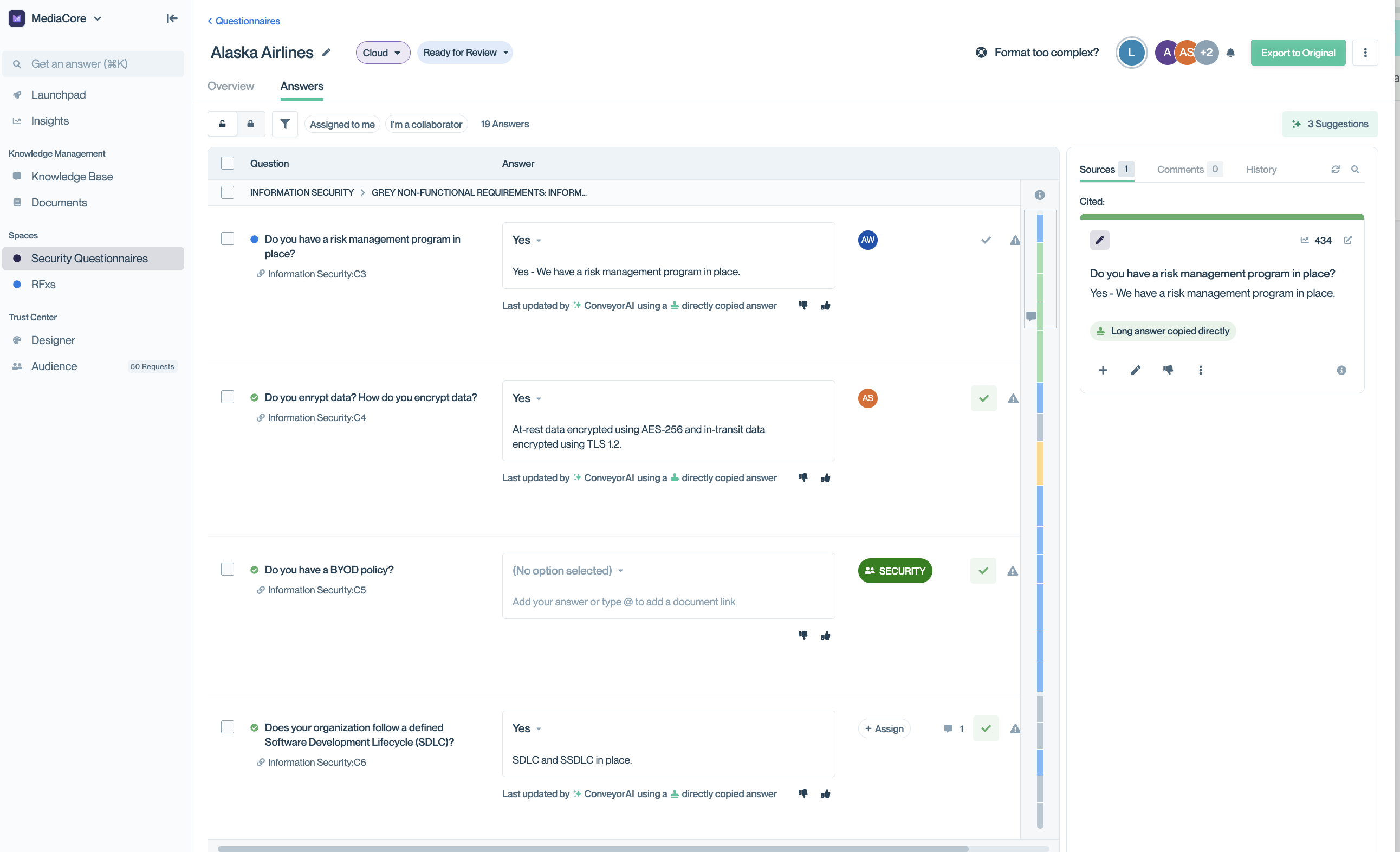
- Map your integration points early: Customer trust platforms like Conveyor rely on your existing documentation. Identify where source-of-truth content lives — CRM, support sites, internal wikis, Trust Centers — and define how it stays current. Response quality depends on it.
- Define ownership and review workflows: Assign clear roles. For example, security owns accuracy and compliance, sales or RevOps drives adoption, and IT supports integrations. Set review rules from day one, including which responses require approval and how exceptions are escalated.
- Drive adoption through process change: Manual workarounds are deeply embedded. The new workflow must be easier than the old one. Provide sales training, keep feedback loops open, and remove friction for users.
Platforms like Conveyor are built for this phased approach, helping teams automate trust workflows while maintaining control and accuracy so you can reach measurable ROI in 90 days, not quarters.
Discover how our customer trust software business case can help you build customer trust, improve customer retention, and deliver better technology solutions — schedule a quick chat to see how it works.
.png)