
Updated September 8, 2026
Most sales and proposal teams already run RFPs through some kind of tool today, and most legacy tools like Loopio and Responsive were great when they first came out. It's 2026 though, and things have changed.
Loopio and Responsive were both built around keyword search and retrieval, matching a question to the closest thing already in your library, and they added AI on top of their existing product in recent years. That's one of the biggest differences between those tools and Conveyor, where we built the AI engine first and the workflow around it.
Why is that distinction important?
The limitations of building AI on top of existing RFP software mean a lot of the automation is clunky, you still have to do many things manually, and answers still require a cumbersome knowledge base that's difficult to maintain.
RFP teams today expect AI-assisted responses that take into account strategy, win themes, instructions, and narrative.
Weak AI that answers without understanding nuance and context means your team spends hours rewriting instead of polishing, and every hour spent improving a bad draft is an hour not spent on another RFP. You can't control whether any single RFP gets won, but you can control how many you get to swing at, and how much strategy makes it into each one.
The bar for AI answering RFPs is a first pass that reads like your best proposal writer wrote it. The human's job is to polish from there.
The tl;dr
Conveyor is the strongest fit if you want AI that understands deal context, win themes, and applies strategy into writing a cohesive RFP for you, with the least ongoing library maintenance. It also automates much of the manual admin work around RFPs like intake, strategy, export, and more. It's also handy if your team handles inbound security questionnaires and doesn't want to run two separate systems. Loopio makes sense if you've already invested years into building a process around it, but the quality of the AI is lacking. Responsive fits organizations running strategic sourcing work well beyond RFP response, on both the buying and selling side.
Security questionnaires are a related but separate workflow. Most RFP tools cover them after the fact using the same answer logic they use for RFPs. Conveyor runs both from one connected knowledge base and applies different judgment to each, since a security question and an RFP question aren't asking for the same kind of answer. Security answers need precision, RFP answers need persuasion, and Conveyor is now smart enough to know the difference.
Loopio vs. Responsive vs. Conveyor at a glance
Where legacy RFP tools create more work than they remove
Both Loopio and Responsive work the same basic way: AI matches an incoming question to your library and suggests the closest approved answer. That holds up when the library is comprehensive and current, and breaks down the moment it goes stale or a question doesn't have a clean match. The quality of the "AI" in that magic button doesn't always deliver, and it's not using generative AI to reason about strategy when it answers.
Ask most proposal teams what their RFP tool doesn't automate, and the answer usually isn't the writing. It's everything around it. Teams end up building manual processes to compensate for what the software should be handling on its own: sorting incoming requests, screening for dealbreakers, routing questions to the right person, and keeping the library from going stale.
One enterprise trust team that uses a legacy RFP tool has to route every request through Salesforce, and every step after that is entirely manual. Someone opens each case, reads the attachments, sizes up the effort, decides who takes the first pass, then uploads it into the RFP tool by hand. That team runs this process with six people handling 700+ requests a month, and still misses its own 15-day turnaround.
Knowledge base maintenance is the stage that comes up on almost every call we have, and it's usually the most difficult and time consuming part of an RFP process. One RFP manager runs a daily 30-minute check-in just to manually re-enter answers from recently closed RFPs into a shared repository, dating and time-stamping each one by hand. With 1,000+ Q&A pairs to maintain, someone's job, every day, just keeping the library from going stale.
Across all of it, the same thing keeps happening: the tool adds a job that didn't exist before, checking its work, on top of the review the team was already doing. For the full stage-by-stage breakdown of where AI is carrying the process and where teams are still compensating for it manually, see The RFP Process: What AI Should Do vs. What It's Actually Doing.
Loopio's reviews

Loopio's platform gets credit on G2 and Capterra for its interface, collaboration features, and support team, which runs a 9.7 out of 10. The recurring complaint sits specifically with the AI: reviewers describe the answer-suggestion engine as inconsistent, and accuracy is directly related to how current the library happens to be. They also flag issues like duplicate entries and imports that need cleanup before they're usable.
Responsive's reviews
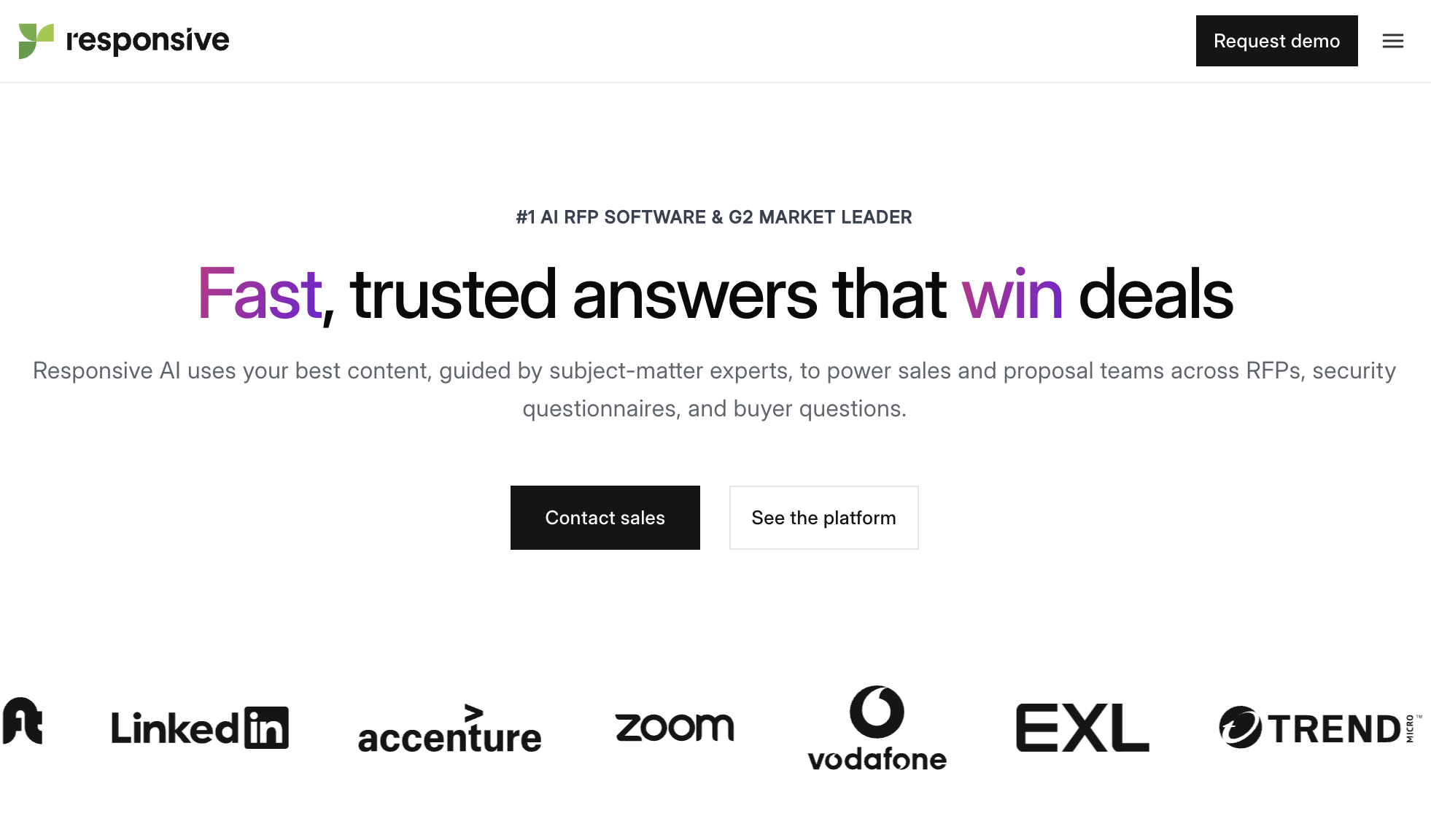
For Responsive, users describe a recent redesign as less intuitive than the version it replaced, and a recurring complaint is that search misses the intent of a question entirely, consistent with a retrieval system built on keyword matching rather than the kind of semantic understanding that catches a differently worded version of the same question. Neither is a knock on the people using these tools. It's the same pattern as what we described above: legacy platforms haven't caught up to where AI is today.
Conveyor: AI that understands strategy, nuance and writes cohesive RFPs
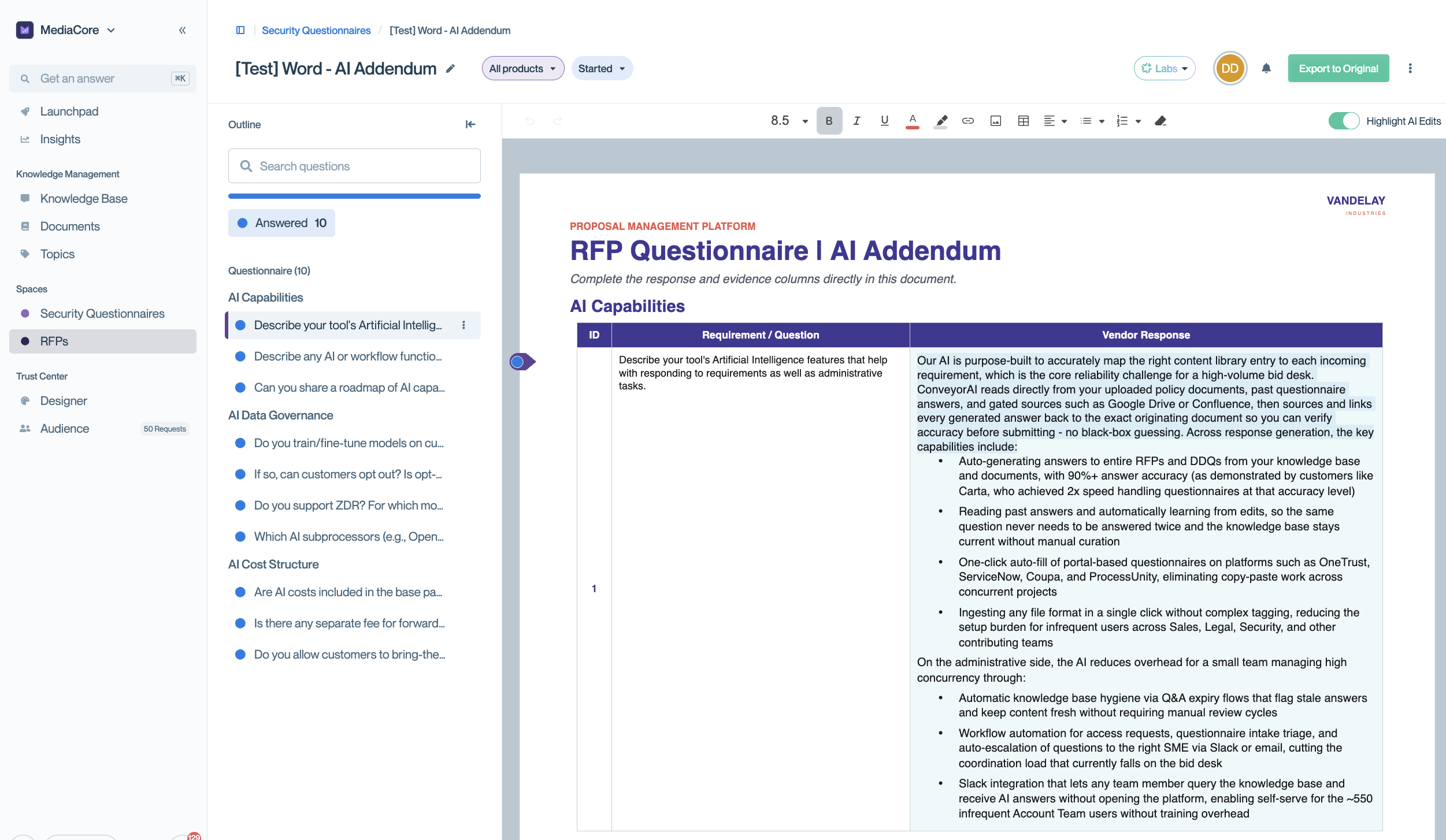
Conveyor currently holds a 4.7 rating across 150+ reviews on G2, with Spring 2025 High Performer and Winter 2025 Momentum Leader badges. Conveyor is also built as an AI-native solution tailored to RFPs, not the other way around. ConveyorAI reads instructions, briefs, and win themes before it retrieves a single source, so context helps the AI generate an answer instead of getting applied after the fact. It maps every question, subquestion, and comment in a file the moment you upload it and decides how long each answer should run rather than applying one global setting. For example, the AI recognizes when it needs a convincing four paragraphs on a capability question and just one line on a straightforward security question. Answers are also written inside the real document format, whether that's Excel, Word, PDF, or a portal like Ariba or OneTrust, instead of an abstracted grid you copy back out by hand.
Legacy RFP tools handle this differently. Spreadsheets break or take 30 to 60 minutes to fix when the format doesn't match cleanly. Context gets applied after the sourcing and answer generation, not before. Because these tools run the same logic on a security questionnaire that they'd run on an RFP, accuracy drops on the questions that need the most precision.
One real trade-off worth naming: Loopio and Responsive have close to a decade of RFP-specific workflow experience. If your team already has a proposal function with years of process built around one of them, ripping that out has its own cost, regardless of which AI answers better. That's an organizational switching cost, worth weighing against what you'd get back in accuracy and maintenance time.
Integrations
Loopio connects to Salesforce, HubSpot, and Microsoft Dynamics for CRM data, plus Google Drive, Box, Slack, and Teams for collaboration. Responsive connects to Salesforce, Pipedrive, and Microsoft Dynamics, along with sales enablement tools like Seismic and Highspot, and Google Sheets.
Conveyor connects to any LLMs, Salesforce, Slack, Teams, DocuSign, Jira, Front, Zendesk, HubSpot, Confluence, and Google Drive, plus a public API for anything custom. None of these lists should be the deciding factor on their own, integrations change often on all three sides, but they're worth checking against your own stack before you commit to a platform that doesn't work with the tools your team already lives in.
Pricing
All three keep detailed pricing off their public sites, so the model matters more than any number you'll find without talking to sales. Loopio prices by number of users. Responsive prices by the number of active projects your team is running. Conveyor prices based on RFP and questionnaire volume, with a free proof-of-concept period so you can test with your own data before signing anything.
Which platform fits your situation
If you're a presales manager or proposal team who wants the highest first-pass accuracy, AI that actually understands strategy, win themes, and context, all without a content library to manually maintain, Conveyor is a great fit. If your team also fields security questionnaires, the same setup handles both from one connected source instead of two.
Loopio is good if you're basing most of your decision on proposal-team collaboration maturity and you're already resourced for it. Responsive wins on workflow breadth if you're managing RFPs, RFIs, and questionnaires across processes that don't currently talk to each other. Conveyor wins on accuracy and total cost of ownership, since under 400 Q&A pairs to maintain against 1,000+ is a different job for whoever owns the library.
Try Conveyor's RFP software for free
If you're currently paying for one tool to handle RFPs and another for security questionnaires, or stitching both together across spreadsheets and old Slack threads, Conveyor is one AI system, one knowledge base that stays updated 24/7 with AI. See the full RFP product breakdown, and check current pricing here.
FAQ
What is RFP response automation? Software that uses AI to handle the repetitive work of answering a request for proposal, pulling in questions, drafting responses from your existing knowledge, assigning reviewers, and formatting the final document, while people keep control of strategy and sign-off.
What's the best software for RFPs? It depends on your setup. Conveyor fits teams that want the highest first-pass accuracy with the least ongoing library maintenance. Loopio fits enterprises with a mature proposal team and an existing content library. Responsive fits organizations running strategic sourcing across many response types at once.
How does Conveyor's AI answer RFP questions? It reads instructions, briefs, and win themes before retrieving a source, so answers are built on context rather than matched to static library snippets. It maps every question and subquestion in a file on import, decides answer length per question instead of using one global setting, and routes questions to the right reviewer based on topic.
How much time does this save? A manual RFP response typically runs 25 to 30 hours. Automation can bring that down to a few hours. On Conveyor specifically, question imports land with a 94% zero-edit rate and a median of 1 minute 41 seconds to a first drafted answer.
Which tool fits a small or scaling team? Conveyor. Loopio and Responsive both assume a proposal function with time to build and maintain a library of 1,000+ Q&A pairs. Conveyor's AI Librarian keeps under 400 pairs current automatically, so a lean team can run RFPs without hiring for it.
Do Loopio, Responsive, and Conveyor all handle security questionnaires too? Not equally. Loopio and Responsive are built RFP-first, with questionnaire support layered on top, using the same answer logic for both. Conveyor runs security questionnaires and RFPs from the same knowledge base and treats the two differently on purpose, so a team fielding both doesn't need a second tool.
What should still get a human review before a response goes out? Pricing and commercial terms, legal language, competitive positioning, and any technical claim that may have changed since the source content was written.
We know there are a lot of tools out there. How do you know which will actually work in your workflow? Test with your own data and team to see which is the best fit for you - schedule a call today.
.png)