-p-1600.avif)
If you're a security leader at a top tech company, your GRC program is probably in great shape. You've got SOC 2 locked down. ISO 27001 is renewed. You have a GRC platform humming along, maybe Vanta, maybe Drata, maybe something homegrown. Your auditors are happy. Your board gets regular updates.
So why do deals still stall in security reviews? Why are sales reps pinging Security channels begging for help with questionnaires? Why do prospects go dark while they wait for security responses?
It's happening because these companies don't trust you yet. You've built a powerful GRC engine, but the car has no wheels. The proof of security isn't reaching your customers.
GRC establishes compliance. Customer trust proves it.
Governance, risk, and compliance is the engine of your trust machine. It's the certifications, the frameworks, the controls, the audit trails. It's internal-facing by design, built to keep your house in order and satisfy regulators, auditors, and board members.
Customer trust is the wheels. It's the outward-facing expression of that work: how your buyers, their security teams, and their procurement departments experience your security posture during the sales process and throughout the customer lifecycle.
Most companies invest heavily in the engine but never put wheels on the car! They build world-class compliance programs and then communicate them through clunky email chains, static PDFs buried in Confluence, bare-bones trust centers, poor sales roll out, and a manual questionnaire response process.
Customer trust is emerging as its own discipline
The most innovative companies have realized this, and are adapting.
Atlassian hired its first Chief Trust Officer in 2021. Salesforce brought on a veteran CTrO in 2024 specifically to work with customers and partners on trust in an AI-first world. DocuSign, Zendesk, Cisco, and HubSpot have all created dedicated trust roles or teams in recent years.
As one ISC2-published security professional put it, the role is "effectively a bridge between the customer and the company on all things security." Strategic work includes working with pre-sales, building out trust centers, owning security knowledge and AI, automating questionnaire responses, and supporting strategic enterprise deals. Tactical work includes responding to security questionnaires, fielding one-off questions, and stepping in when a deal is at risk because of a security concern.
The pattern is clear: companies that take customer trust seriously treat it as a distinct function sitting at the intersection of security, sales, and customer success.
You can't sell to the enterprise without trust
Security reviews have become the hidden deal-killer in enterprise SaaS.
Enterprise sales cycles already stretch 90 to 180+ days for six-figure deals. Security questionnaires routinely add weeks — sometimes months — to that timeline. And in a downturn, that delay is often fatal.
The mechanics are painfully familiar. The deal is almost done. Your champion is on board. Pricing is agreed. Then procurement sends a 200-question security questionnaire. Your sales team scrambles to find the right people internally. Engineering gets pulled in. Legal weighs in. Emails bounce back and forth. The buyer goes quiet. Two weeks later the review closes or the deal dies, or a competitor scoops it.
Every company feels this pain. Most just accept it as the cost of selling to the enterprise. But that's a choice, not an inevitability.
The best companies invest in customer trust
When Atlassian's CTrO Vikram Rao describes his role, he frames it around customer acquisition and customer success. During the sales cycle, his team explains how the platform handles security, compliance, and privacy. After the sale, they help customers make the most of those features. His key metrics? Customer retention, growth, and proactive risk management.

This is the shift. Customer Trust isn't a side project for the security team. It's a strategic function that directly impacts revenue.
Security-conscious enterprise teams are starting to rethink how they show up in the sales cycle. Instead of grinding through questionnaires line by line, the best ones are getting in front of customers directly, walking them live through their security program, and turning the review process into a relationship building moment. Customers respond better to it too.
The companies that invest in Customer Trust in this way see the results: faster deal cycles, fewer questionnaire bottlenecks, less time wasted by security engineers on repetitive work, and sales teams that can actually spend their time selling.
You don't need a 10-person team. You need a customer trust platform.
Most companies aren't going to hire a Chief Trust Officer and build a dedicated team tomorrow. That's fine. The opportunity right now is to use AI and purpose-built software to get the outcomes of a customer trust program without staffing one from scratch.
That's what a Customer Trust Platform is built for. The big GRC tools will tell you they do customer trust (in addition to everything else) but the tools for Customer Trust are fundamentally different from a GRC tool with a trust center bolted on.
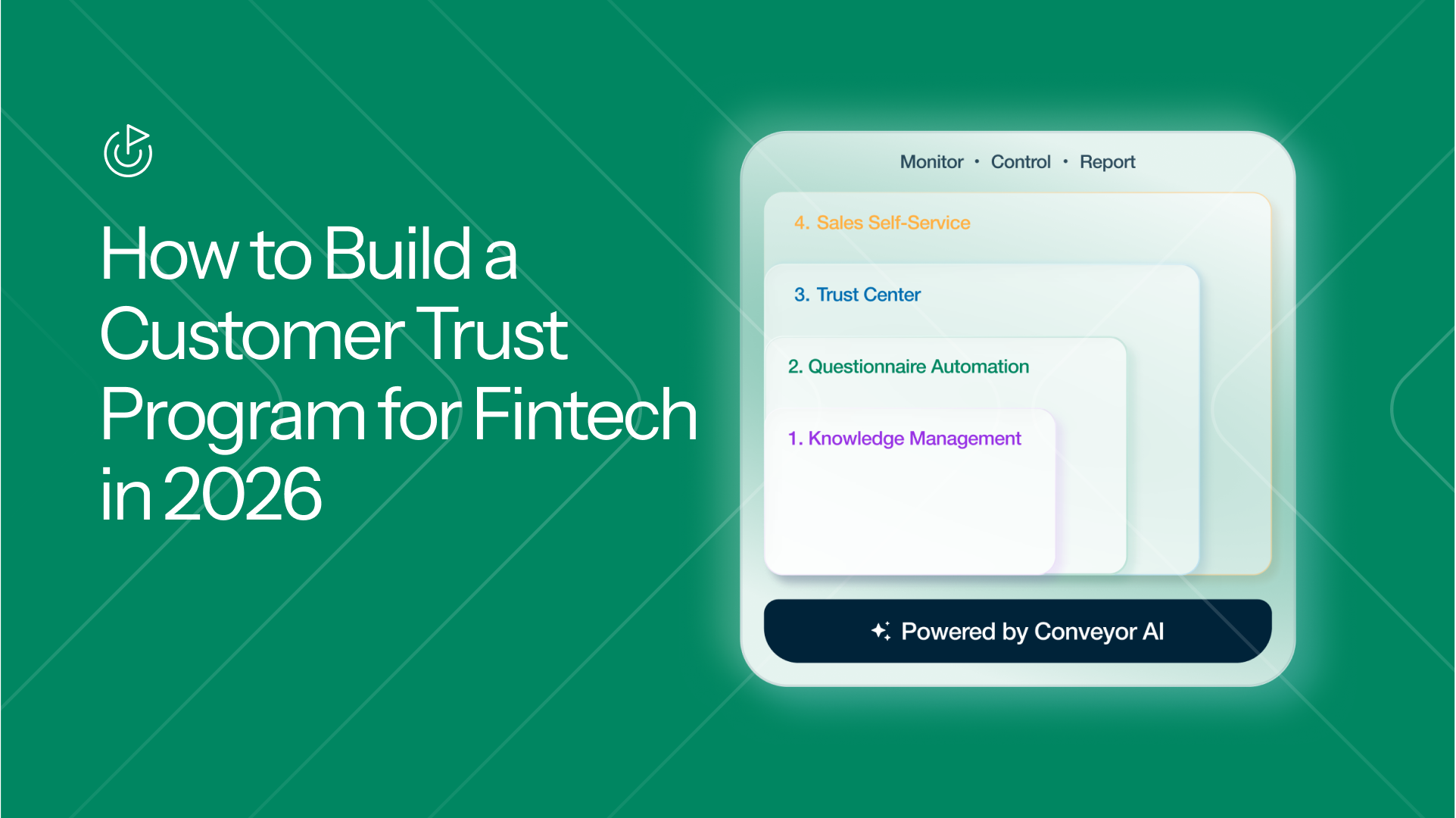
A true Customer Trust Platform has five layers.
A single source of truth for your security knowledge. Before you can communicate trust, you need to consolidate it. That means pulling together your security policies, certifications, questionnaire history, and compliance documentation into a centralized, AI-powered knowledge base. AI-powered because this single source of truth must be monitored and maintained. Historically that's a challenge if it's only being watched by a human. AI can and should do that work.
AI-powered questionnaire automation. Security questionnaires are the biggest bottleneck in the sales cycle. A Customer Trust Platform uses that consolidated knowledge to power an AI engine that drafts accurate, consistent responses. It learns as questionnaires evolve, so you're never starting from scratch or pasting in past answers. You build a review process around that. Customizing the level of automation and review to balance speed with rigor. Maybe a small team works on them, maybe you have only a single reviewer with the process going 100% touchless. Either way the best implementations turn what used to take many humans days into something one person does in hours, without sacrificing accuracy.
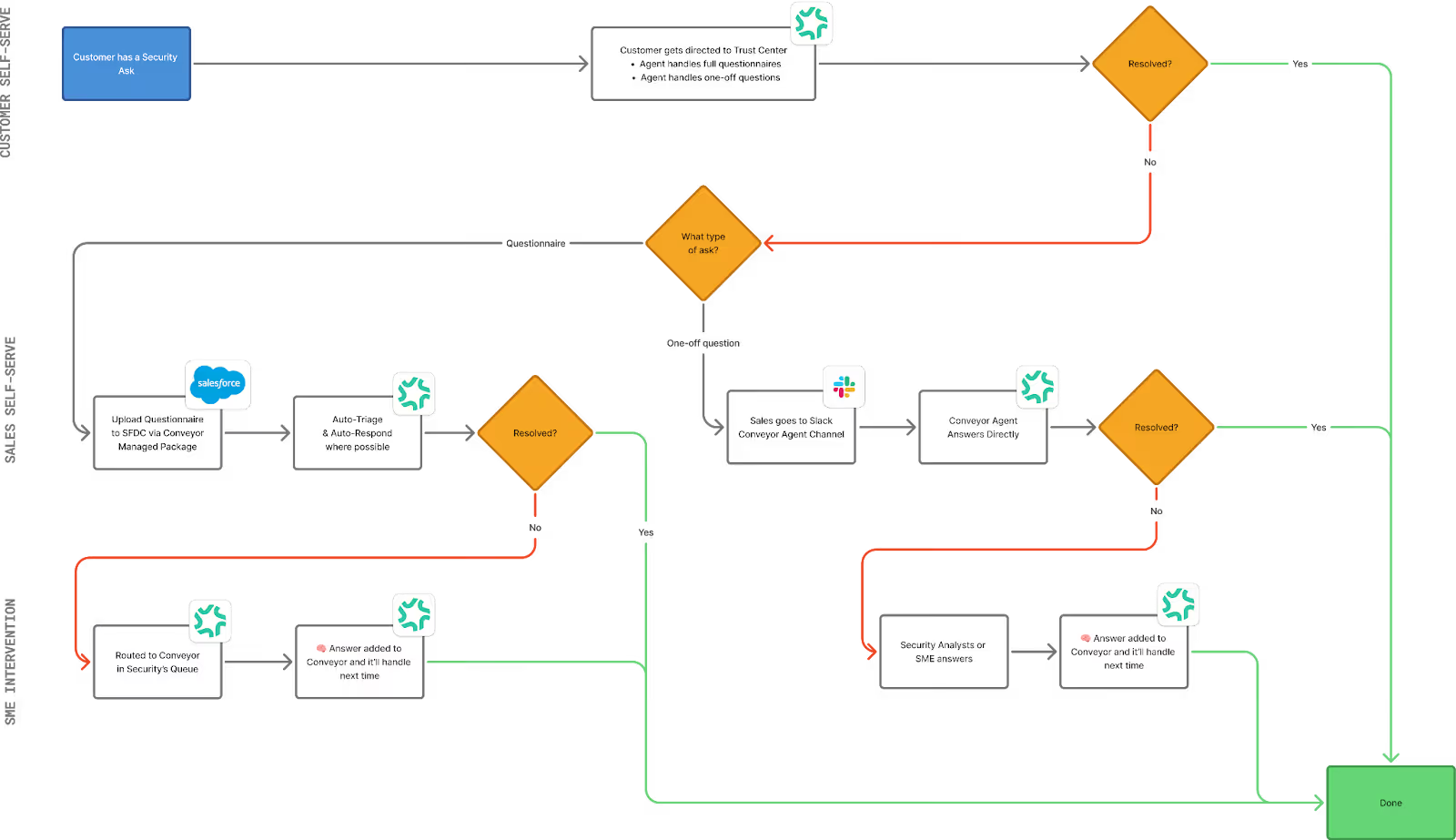
An AI-powered trust center that lets buyers self-serve. The current Trust Center tools market is sad. Most Trust Centers look the same but they are not created equal. A bad one looks nice but doesn't actually help customers self-serve. The result is that customer requests bounce off it and straight to you. A helpful trust center is powered by an AI agent that can answer buyer questions in real time, surface the right documentation, handle NDA workflows automatically, and process entire questionnaires that are uploaded to it. When a prospect can get what they need without waiting for your team to respond, the security review stops being a bottleneck and starts being a competitive advantage.
A sales-facing AI agent that extends trust to the front lines. This is the layer that the GRC tools really ignore. Your sales team and sales engineers are the first people a buyer asks about security. Today, they either deflect ("let me connect you with our security team") or they wing it. A complete Customer Trust Platform puts an AI agent directly in the hands of your go-to-market team so they can answer security questions confidently and immediately, during a meeting if they need to. Customer Trust Agents live in their workflows and tools like Salesforce and Slack so they can easily self-serve.
GRC tools are great at what they do. This just isn't what they do.
GRC tools are built to manage your internal compliance program. They're excellent at tracking controls, managing evidence, and preparing for audits. That's their job, and the good ones do it well.
But Customer Trust is a different problem and if you're serious about it, you need a dedicated solution. This is how you'll alleviate your team from the manual way of communicating trust, and accelerate sales cycles. You're turning the great work your security team has already done into something your sales team and your buyers can actually use.
Some GRC vendors have added trust centers or basic questionnaire features. But you'll find that they are extensions of an internal compliance tool, not purpose-built customer trust solutions. The difference shows up in the quality of AI responses, the depth of customer-facing features, and especially in whether the platform extends to the sales team — the people who need it most.
The bifurcation is happening. The question is where you land.
Every major enterprise tech company already has a GRC program. That's table stakes. The question now is whether you're going to build a real customer trust program alongside it. If you keep treating customer-facing security work as an afterthought you're going to be looked at like a cost center.
The smartest companies recognize that GRC and customer trust are complementary but distinct. They're investing in people, processes, and platforms that turn security work into sales effectiveness and buyer confidence.
You've already done the hard part. Your security program is solid. Now it's time to make sure your customers know it.
Conveyor is the AI-Native Customer Trust Platform built for the enterprise. We help Customer Trust teams automate the security questionnaire workflow, leverage AI to work faster and smarter, build a better process with sales, and overall build real customer trust.
.png)